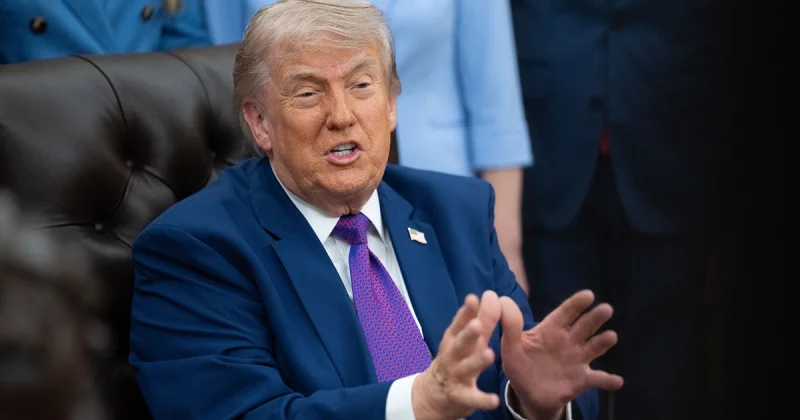
Venezuela will not become the 51st U.S. state, Delcy Rodríguez said Monday, rejecting Donald Trump’s remark that he was seriously considering the idea. Speaking at the International Court of Justice in The Hague on the final day of hearings in the long-running border dispute with Guyana, she said Venezuela would keep defending its integrity, sovereignty, independence and history.
“We are not a colony, but a free country,” Rodríguez told journalists. Her comments came as Trump told News on Monday that he was seriously considering making Venezuela the 51st U.S. state. The White House did not immediately respond to a request for comment, and later White House spokesperson Anna Kelly declined to comment on Trump’s plans. Kelly said Trump was famous for never accepting the status quo and said Rodríguez was working incredibly cooperatively with the U.S.


Rodríguez also said Venezuelan and U.S. officials have been in touch and are working on cooperation and understanding. She was at The Hague to defend Venezuela’s claim to Essequibo, a 62,000-square-mile region that makes up two-thirds of Guyana and sits near massive offshore oil deposits that are currently producing an average 900,000 barrels a day. The area is also rich in gold, diamonds, timber and other natural resources, and it has been at the center of a territorial fight that has hardened for more than a century.
Venezuela has considered Essequibo its own since the Spanish colonial period. An 1899 decision by arbitrators from Britain, Russia and the United States drew the border along the Essequibo River largely in Guyana’s favor, but Venezuela says a 1966 agreement in Geneva effectively nullified that ruling. Guyana took the issue to the International Court of Justice in 2018 after ExxonMobil announced a significant oil discovery off the Essequibo coast, asking judges to uphold the 1899 decision.
The dispute flared again in 2023 after Nicolás Maduro threatened to annex the region by force following a referendum asking voters if Essequibo should become a Venezuelan state. Rodríguez said the dispute should be settled through political negotiations, not a judicial ruling, underscoring how far apart the two sides remain even as Washington and Caracas keep talking on other issues. With Venezuela producing about 1 million barrels of oil a day and the region tied to some of South America’s most valuable energy reserves, the court fight is no longer just about a border. It is about control, leverage and who gets to decide the future of one of the continent’s most contested stretches of land.