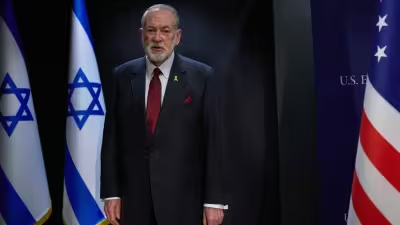
The White House said the United States will hold direct talks with Iran, with Vice President JD Vance leading a delegation to Islamabad that includes special envoy Steve Witkoff and Jared Kushner. The first round is set for Saturday morning local time, as the region strains under a fragile ceasefire in a six-week conflict.
The talks are being launched while fighting in the Middle East continues to threaten the agreement. Israeli strikes in Lebanon kept going during the ceasefire period, and Iranian officials said those strikes violated the terms of the day-old deal. Abbas Araghchi said the terms were “clear and explicit” and that Washington had to choose between ceasefire and continued war via Israel. Mohammad-Bagher Ghalibaf said fighting in Lebanon, an alleged drone incursion into Iranian airspace and the denial of Iran’s right to enrichment made a bilateral ceasefire or negotiations unreasonable.
The urgency is not theoretical. President Donald Trump said the Strait of Hormuz should be reopened immediately, after Iran’s semi-official Fars news agency reported that oil tanker passage through the strait had been halted following Israeli strikes. Vance said “we are seeing signs that the straits are starting to reopen,” while also saying Israel had agreed to “check themselves a little bit in Lebanon” to help negotiations. More than 800 freighters were stuck inside the Persian Gulf, mostly waiting to leave, and only three ships were observed leaving on Wednesday, according to ship-tracking data. In normal times, about 135 ships cross daily.

Read Also: Pentagon Pope: Vatican diplomat summoned over pressure to back Trump
The friction runs through every part of the ceasefire. Earlier Wednesday, Trump said Lebanon was not part of the agreement but said he was confident the campaign would not undercut the broader deal. On Wednesday evening, Emmanuel Macron condemned the Israeli strikes in Lebanon and said they caused heavy civilian casualties. The Israeli military said it struck more than 100 Hezbollah targets within 10 minutes, and Prime Minister Benjamin Netanyahu said the campaign had set back Iran’s capabilities but that the war was not over.
The direct talks now carry a clear test: whether Washington can keep Iran at the table while fighting in Lebanon and pressure around the Strait of Hormuz keep the region on edge. Vance said the administration was “on the right track,” but the next move will be judged by what happens on the ground in Lebanon and at sea, not by the promise of a meeting in Islamabad.