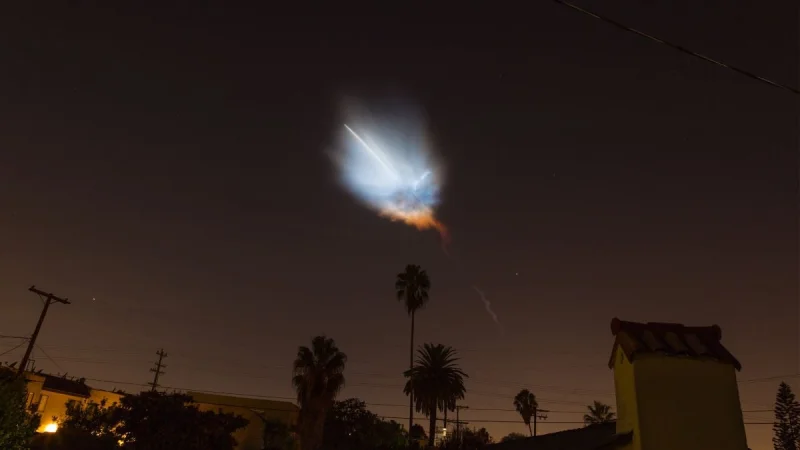
A spent SpaceX Falcon 9 upper stage is predicted to hit the Moon on Aug. 5, 2026, at about 06:44 UTC, with the impact expected near Einstein crater. Independent astronomer Bill Gray said the object’s path points to a collision at roughly 02:44 EDT.
The object is the upper stage of the 2025-010D Falcon 9 rocket, which launched in January 2025 carrying two Moon landers, Blue Ghost mission 1 and Hakuto-R Mission 2. Gray said the motion of space junk is mostly predictable because it follows the gravity of the Earth, Moon, Sun and planets, and noted that on Aug. 5 the stage and the Moon will reach the same point at the same time.
The stage now takes about 26 days to orbit Earth, coming as close as 220,000 kilometers, or 137,000 miles, at perigee and reaching about 510,000 kilometers at apogee. The Moon sits at an average distance of about 400,000 kilometers from Earth, which is why the stage’s wide looping path keeps bringing it back into the Moon’s neighborhood. The collision is expected to leave a fresh crater.



That would make it another entry in a long, messy record of objects hitting the lunar surface. Multiple Apollo modules smashed onto the Moon in the 1970s, NASA deliberately crashed its LCROSS probe there in 2009, and a booster thought to be from China’s Chang'e 5-T1 mission is believed to have struck the far side in 2022.
The difference this time is that the impact would not be a planned experiment or a controlled disposal, but the final consequence of a non-reusable rocket stage left in orbit after launch. Gray’s analysis suggests the outcome is now essentially set, and the Moon is likely to take the hit in broad daylight for observers in ET time zones, even if the crater itself will remain on the far side from Earth’s view.
The more immediate question is not whether the stage will reach the Moon, but what observers can learn from the impact as it happens. If Gray’s calculation holds, the Falcon 9 lunar collision will arrive on schedule and add one more fresh mark to the Moon’s surface.