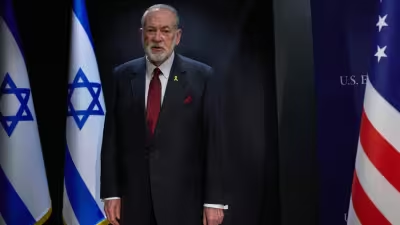
Robert Kagan argues that Democrats are still not answering Donald Trump with the urgency the moment demands, warning that the party has not yet settled on a message strong enough to meet the threat he represents.
That is the core of his latest political intervention, and it lands now because the presidential campaign is entering a phase in which every public argument about Trump’s record, his return to power and the state of American democracy is becoming harder to ignore. Kagan, a longtime foreign policy writer and a sharp critic of Trump, has spent years pressing the same warning, but this time he is putting it directly at the center of the campaign fight.



His case is not simply that Trump is dangerous. It is that Democrats have to say so in a way that ordinary voters can feel, not just agree with in principle. Kagan’s argument is aimed at a party that has often leaned on process, caution and institutional language, even as Trump has turned the election into a test of whether voters want another turn with a president who has already reshaped the Republican Party around himself.
The friction is that this kind of warning has limits. Democrats want to keep voters focused on Trump’s conduct and the risks of another term, but they also know that a campaign built only on alarm can sound abstract after years of political combat. Kagan is pushing them toward a harsher, clearer choice, while the party still has to decide how much of its message should be about Trump himself and how much should be about the future he would bring with him.
What makes the argument matter today is that campaigns move quickly once voters settle into a frame. Kagan is trying to shape that frame now, before Trump’s own story defines the race completely. Whether Democrats adopt his tone or not, his warning captures the problem they face: if they do not make the election feel like a direct choice about the country’s direction, Trump will do it for them.