
Russia test-fired a new intercontinental ballistic missile on Tuesday, and Vladimir Putin said the nuclear-armed Sarmat would enter combat service at the end of the year. He called it the most powerful missile in the world.
Putin said the weapon’s individually targeted warheads deliver more than four times the power of any Western counterpart, and that it can fly more than 21,700 miles, carry up to 10 tons and evade prospective missile defenses. The Sarmat, known by NATO as Satan II, is a heavy ICBM built to replace the aging Soviet-made Voyevoda.
The test matters because it came as Moscow keeps pressing ahead with the modernization of its nuclear triad. Russia has already deployed hundreds of new land-based intercontinental ballistic missiles, commissioned new nuclear submarines and modernized nuclear-capable bombers, even as the last remaining nuclear arms pact between Russia and the U.S. expired in February.
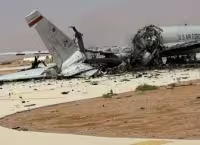
The Sarmat’s path has been uneven. Development began in 2011, and before Tuesday it had only one known successful test. A reported test in 2024 suffered a massive explosion, underscoring how much of Russia’s strategic arsenal remains in transition even as the Kremlin presents it as ready for service.


Putin first revealed the Sarmat in 2018 as one of several new weapons he said would make U.S. missile defenses useless. Since then, the Avangard hypersonic glide vehicle has entered service, Russia has commissioned the nuclear-capable Oreshnik intermediate-range ballistic missile and used a conventionally armed version of Oreshnik twice to strike Ukraine. Putin has also said Russia is in the final stages of developing the nuclear-armed Poseidon underwater drone and the Burevestnik cruise missile.
The fresh test-fire lands against a broader backdrop of friction that extends beyond this missile alone. Russia and the U.S. agreed in February to reestablish formal, high-level military communications, but the expiration of the arms pact removed caps on the two largest atomic arsenals. That leaves both sides modernizing and signaling at the same time, with little in place to slow the pace.
For Putin, the Sarmat is meant to project control over that pace. For everyone else, Tuesday’s launch was a reminder that the most dangerous part of the nuclear competition is not over. It is being updated.