Russian intelligence provided Iran with a detailed list of 55 critical energy infrastructure targets inside Israel, according to a report that says the material could help Tehran carry out precision missile strikes against the country’s power grid.
The targets were divided into three categories. Level 1 included critical production facilities whose destruction could cripple the national energy system, and the report named the Orot Rabin power station as a primary target. Level 2 covered major urban and industrial energy hubs, mostly in central Israel. Level 3 included local infrastructure such as regional substations that support industrial zones and smaller power plants.
The assessment behind the list described Israel’s grid as highly isolated, unlike the systems of many European countries. It said Israel is an energy island that does not import electricity from neighboring states, and warned that damage to even a few central components could trigger a total and prolonged energy collapse.

Volodymyr Zelensky said the transfer of battlefield knowledge from Ukraine to the Middle East was already under way. He said the Russians also helped Iran after Iran helped Russia at the beginning of the war by giving them Shaheds, and added that Russia has begun supplying Iran with Shahed-style drones made on Russian soil. He also said Russian components were found in a drone recently shot down in a Middle Eastern country, which he declined to identify for security reasons.
For Ukraine, the allegation points to a wider problem than one intelligence exchange. Officials say any Russian transfer of battlefield knowledge would bolster Moscow’s primary ally in the region and could help create a fresh Middle East crisis that pulls attention and resources away from the war in Ukraine. That is why the reported list of targets matters now: it suggests the Russian-Iranian relationship is not just rhetorical support, but operational cooperation tied to real military planning.
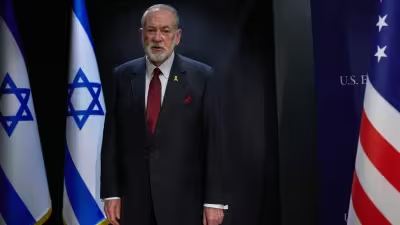
Russian ambassador Anatoly Viktorov denied that Moscow provides intelligence data to Iran. He said Russia and Israel established contacts long ago to discuss national security issues, that the contacts have been intensively maintained between relevant agencies, and that the most pressing issues have been discussed at the highest level. Viktorov added that Russia values the track record built in that channel. The contradiction is stark: one side says intelligence is being exported into a new theater, while Moscow insists the coordination remains official, longstanding and unrelated to the alleged transfer.