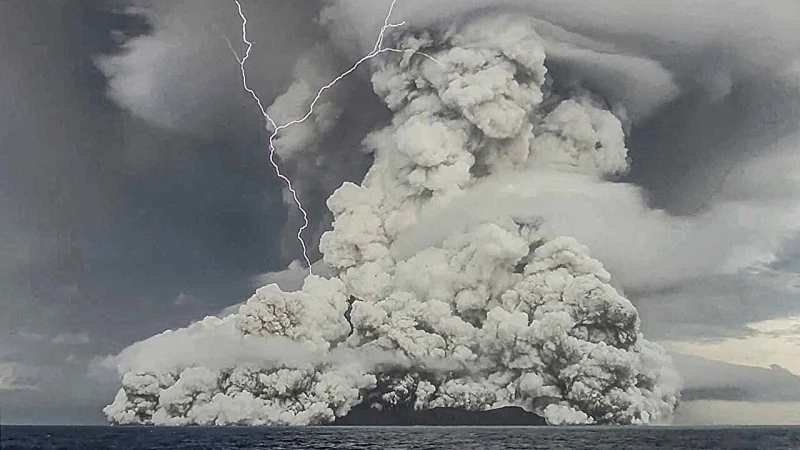
A submarine volcano that ripped apart the South Pacific in January 2022 may have done more than blast ash and seawater high into the air. It may also have helped clean up methane.
Researchers who studied the Hunga Tonga–Hunga Ha'apai eruption said they found unusually high concentrations of formaldehyde in the massive volcanic plume, a chemical clue that methane was being destroyed as the cloud traveled for 10 days, all the way to South America. Formaldehyde is a short-lived intermediate that forms when methane breaks down in the atmosphere, and its presence in such a long-lived plume meant the cloud must have been stripping methane continuously for more than a week.
Maarten van Herpen, one of the study’s researchers, said they were surprised by what the satellite images showed: a cloud with a record-high concentration of formaldehyde that could be tracked for 10 days. Because formaldehyde only survives for a few hours, he said, the finding showed the plume had been destroying methane for more than a week. The study was published in Nature Communications on May 7, 2026, and it builds on a 2023 discovery that a related chlorine-producing process can form when Sahara dust blown across the Atlantic mixes with sea salt and sunlight.


The 2022 eruption hurled enormous amounts of salty seawater into the stratosphere along with volcanic ash. The researchers think sunlight hitting that mix produced highly reactive chlorine that attacked methane released during the eruption. Matthew Johnson said what was new, and completely surprising, was that the same mechanism appeared to be working inside a volcanic plume high in the stratosphere, where the physical conditions are entirely different. Van Herpen added that while it was already known that volcanoes emit methane during eruptions, it was not previously known that volcanic ash could partially clean up that pollution.
The finding matters because methane is responsible for one third of global warming and is about 80 times as potent as CO2 over 20 years, even though it usually breaks down in about 10 years. That makes methane cuts one of the fastest ways to affect the climate, what researchers sometimes call an emergency brake. Reducing methane could produce a noticeable climate benefit within a decade, even as CO2 cuts remain essential to stabilize temperatures over the long term.
The study does not suggest volcanoes are a practical climate solution. It does, however, show that the chemistry of a violent eruption can briefly turn the atmosphere against methane rather than merely adding to the burden. And while the Hunga Tonga plume traveled across half the Pacific, the most important question now is whether scientists can use what they learned from this strange natural experiment to sharpen the fight over one of the planet’s most powerful warming gases.