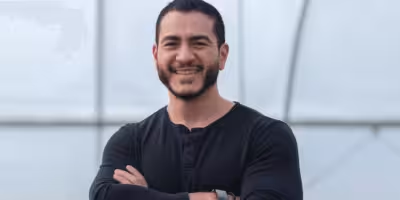
Liban Mohamed, a 27-year-old son of Somali immigrants, is heading into June’s high-stakes Utah Democratic primary after narrowly winning the state party convention last month with 51% of the vote. He defeated former congressman and former Salt Lake County mayor Ben McAdams in a race that is now turning into a test of whether the Democratic Party’s younger, more progressive wing can turn convention momentum into a primary victory.
Mohamed’s climb has come fast, but the polling has not. He is still in the single digits, while McAdams and Nate Blouin hold double-digit leads. All four candidates in the race — Mohamed, McAdams, Blouin and Michael Farrell — qualified for the primary through signatures, giving voters a broader choice after the convention fight.
The campaign is unfolding in Utah’s first congressional district, which was redrawn after the state supreme court struck down Republican-drawn maps in an anti-gerrymandering ruling early this year. The new district, centered on Salt Lake County, is more compact, more Democratic-leaning, more diverse, younger and largely progressive-leaning than before. Mohamed, who previously worked in public policy at Meta and TikTok, has tried to make that shift the center of his argument. He said the district includes 60,000 refugees, 60,000 Muslims and nearly 120,000 people from the Latinx community, and argued that voters are ready to break with the past.
“The definition of insanity is trying the same thing over and over and expecting a different result,” Mohamed said, casting the race as a demand for something new. He also said, “Utahns are willing to take a risk on hope over the certainty of the status quo.”
The friction inside the race is showing up most clearly in the party’s own divisions. The contest reflects a split between the Democratic establishment and a younger, more progressive bloc, and Mohamed’s rise has been described by some Utah Democratic figures as another “Mamdani moment.” That dynamic matters because it gives the primary the feel of a larger argument over what kind of Democratic Party Utah wants to be in a district that has moved left after the court-ordered remapping.
The race has also been shaped by the weaknesses of Mohamed’s rivals. Blouin faced backlash after resurfaced online posts included jokes about sexual assault, slurs and comments denigrating members of the Mormon faith. Eva Lopez Chavez, who was accused of unwanted sexual advances by multiple people and denied the allegations, was eliminated in the first round of voting at the convention. Those developments helped clear the field for Mohamed’s surprise convention win, even as the primary electorate may look very different from the delegates who handed him 51% last month.
Mohamed has framed the district’s political change as a demographic one as much as an ideological one. “In a lot of ways, many people here see themselves as refugees,” he said. “So when they see families coming from places like where mine came from, seeking asylum, they have a soft place in their hearts.” He added, “This district is not what most people think,” a line that captures both his campaign and the case he is making to a skeptical party: that the old playbook no longer fits the new map. The question now is whether June voters will accept that argument or stick with the Democratic Party’s familiar names.