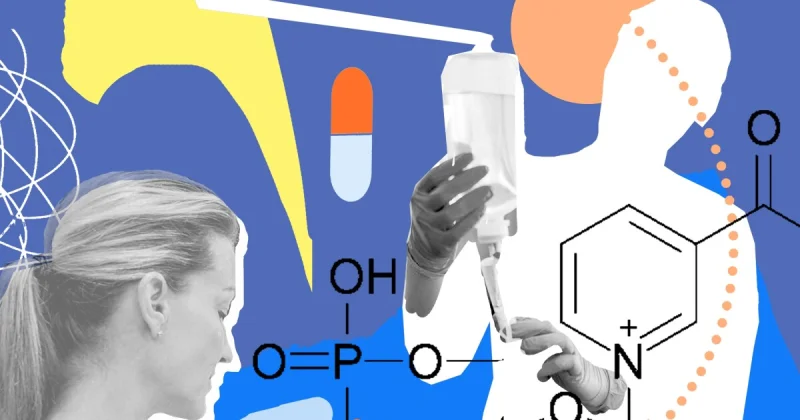
Scientists studying nicotinamide adenine dinucleotide, or NAD+, are watching a wave of hype build around a molecule that sits at the center of how cells make energy and repair DNA. The market for NAD+ boosters, injectables and IV infusions has surged through the wellness and longevity world, with marketers promising more energy, better recovery and protection against aging.
That pitch has turned NAD+ into a booming business, with some clinics selling therapies as a cellular fountain of youth for hundreds or thousands of dollars. Christopher Martens, who studies the compound, said, “Initially it was exciting.” But he added, “I think now the cart may be well ahead of the horse.”
The gap between the sales pitch and the science is the reason researchers are being more careful now than they were a few years ago. NAD+ levels fall as people age, and the molecule is deeply involved in mitochondrial energy production and in keeping cells healthy through DNA repair. The body also makes it from dietary precursors, mainly vitamin B3 and the amino acid tryptophan, which is part of why interest in boosting it has proved so durable.
Shalender Bhasin put the appeal plainly: “As a hypothesis, as an idea, it's very attractive.” But he also said, “But we are still in the early stages of human studies and the health benefits of augmenting NAD+ are yet to be established in large human studies.”
That caution matters because much of the enthusiasm comes from animal work, not human evidence. In rodents and mice, NAD+ has been described as miraculous, with preclinical studies showing improved mitochondrial health, more strength and exercise performance, and less inflammation and metabolic trouble. In humans, the picture is far less clear.
Most clinical research has focused not on NAD+ itself but on its precursors, NR and NMN, and the trials have usually been small. Some human studies have reported encouraging results in women with prediabetes, newly diagnosed patients with Parkinson's disease and people with peripheral artery disease. Other trials aimed at metabolic health did not come close to reproducing the striking findings seen in animals.
That split is what leaves the field in a familiar place: a legitimate scientific idea that has raced into the market before the evidence has caught up. It is not the first time a therapy has been sold more quickly than it could be tested, and it will not be the last. A similar gap between hype and proof has surfaced in other high-stakes cases, from the El Chapo case hearing delayed as judge cites new evidence review to Savannah Guthrie: DNA evidence could crack Nancy Guthrie cold case.
Samuel Klein was blunt about the divide. “In rodents and mice — not in humans — NAD+ is miraculous,” he said.
For now, that is the key fact behind the boom: NAD+ may still prove useful, but the consumer market has moved faster than the human studies. The promise is real enough to draw attention. The proof, so far, is not.