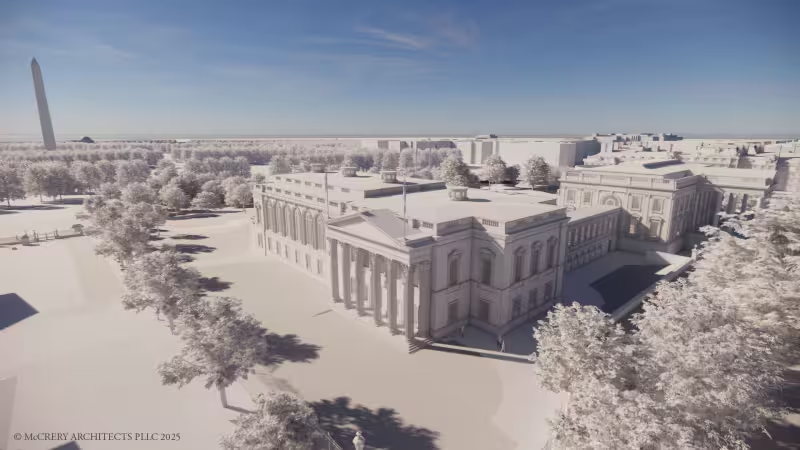
President Donald Trump’s plan to tear down the White House East Wing and replace it with an enormous ballroom cannot move forward without Congress, a federal judge said last week, and the Justice Department tried late Friday to put that ruling on hold.
U.S. District Judge Richard J. Leon issued a preliminary injunction in a lawsuit brought by the National Trust for Historic Preservation last December, saying the ballroom construction project must stop until Congress authorizes its completion. In a 35-page opinion, Leon wrote that the president is the steward of the White House for future generations of First Families, but not the owner, and that no statute comes close to giving him the authority he claims.
Leon’s ruling lands in the middle of a fight over how far the White House can go on its own. Trump announced the ballroom plan last July, and the administration has relied mainly on 3 USC 105(d), which authorizes the use of appropriated money for work on the Executive Residence at the White House. The administration has also said the project would be paid for with private funds.
Read Also: Donald Trump Spurs Dow Jones Industrial Average 0.3% Gain Ahead


The judge rejected that reading in sharp language. He said Section 105(d) plainly allows ordinary maintenance and upkeep, not wholesale demolition and new construction, comparing it to replacing lightbulbs, fixing broken furniture and changing wallpaper. He wrote, “A brazen interpretation, indeed!”
The project would demolish the East Wing and replace it with a structure 60 percent larger than the White House residence in square footage and more than three times as large in cubic volume. Critics objected on architectural grounds, including the asymmetry of the design, the obstruction of the line of sight between the Capitol and the president’s residence, and the original portico design.
Read Also: Justice Department opinion targets Presidential Records Act in Trump-era reversal
The Constitution gives Congress complete authority over public lands, along with legislative authority over the District of Columbia and control over federal spending. That is the legal wall Leon said Trump had run into. He concluded that the National Trust is likely to succeed on the merits because the law does not give the president the power to remake the White House this way.
The Justice Department’s emergency motion late Friday asks a federal appeals court to block the injunction while the fight continues. For now, the answer to whether Trump can proceed is no: not without Congress.