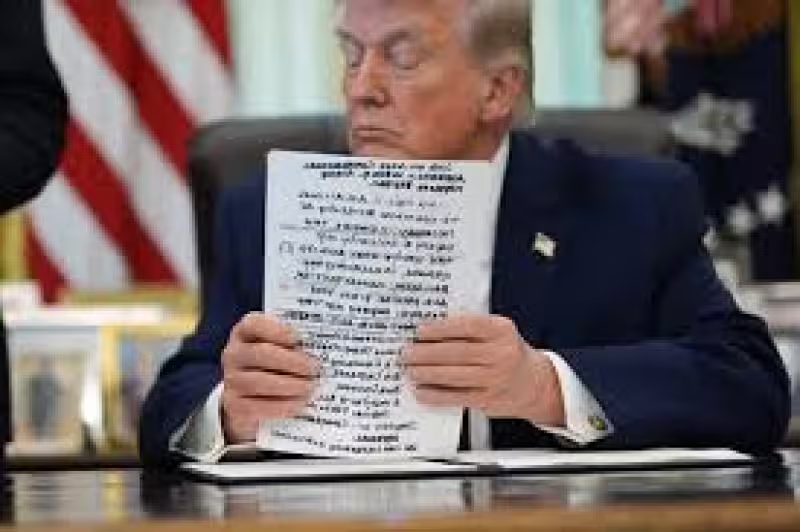
The Trump administration last week published a 52-page Justice Department legal opinion declaring the Presidential Records Act unconstitutional, a sharp break with the law that governs what presidents must keep and turn over. The opinion was written by T. Elliot Gaiser, an Ohio-based election denier and former clerk of Samuel Alito.
Gaiser argued that Congress had no right to tell a president to preserve records. He wrote that the duty to create and keep documents served “no legislative purpose” and could “impede” the day-to-day “performance” of the head of the executive. That view lands in the middle of a broader push by Trump to narrow the public’s reach into presidential records after years in which his own handling of documents became a legal and political problem.
The law Gaiser targeted was built to stop a repeat of the Nixon era. In 1974, Congress passed the Presidential Recordings and Materials Preservation Act and made the government take custody of Richard Nixon’s materials. The Supreme Court rejected the argument that separation of powers had been violated and said the public had an interest in “the American people’s ability to reconstruct and come to terms with their history.” Congress later followed with the more general Presidential Records Act in 1978.


Read Also: Harmeet Dhillon Promotion Discussed for Top Justice Department Role
That statute sat largely in the background until Trump. After the end of his first administration, he took documents from the White House to Florida, a case that helped produce 40 felony counts for mishandling classified documents in Jack Smith’s report. Aileen Cannon will not release that report. Trump also fired the archivist of the United States last year and replaced the first woman to hold the job permanently with Marco Rubio. He has drawn on the services of the president of the Richard Nixon Foundation, and he pardoned even the most violent January 6 insurrectionists while people involved in establishing the facts about the attack were removed from the FBI and the Justice Department.
The tension in the new opinion is plain: Trump’s team is attacking a records law that was meant to stop presidents from hiding their own history, just as his administration has taken steps that make records harder to preserve and harder to recover. He once said, “I don’t believe in building libraries or museums.” Now his Justice Department is arguing that Congress never had the power to make him keep the papers at all.