A magnitude 5.5 earthquake centered about 12 miles from Silver Springs shook western Nevada on Monday evening, jolting a state that scientists say sits in one of the most active seismic regions in the country. The quake landed just before about 180 medical students at the University of Nevada, Reno took part in a training exercise on Tuesday built around responding after a major earthquake.
Kyren Bogolub said the shaking ranks among the biggest earthquakes Nevada has seen in decades. She said it was about the seventh largest earthquake in the state in the last 60 years or so, a reminder that the ground in this part of the West can move hard and without much warning. Jennifer Delaney put the risk in broader terms on Tuesday, saying Nevada is the third most seismically active state in the Union, after California and Alaska.
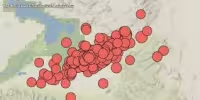
The quake was tied to the Walker Lane, a highly active system of faults that runs for about 600 miles along the Nevada-California border. Bogolub said the Walker Lane is probably the most seismically active part of Nevada, and she said getting a magnitude 7 would not be shocking to her. That is the scale of threat the UNR exercise was meant to address, even though the training had been scheduled before Monday night’s quake.
For the students, the timing made the lesson harder to ignore. Ozzie Tavares said the earthquake one day earlier made the exercise feel more serious, adding that Nevada is always at risk for something like this to happen. The state had not just a classroom warning but a fresh reminder, and the gap between the two was less than 24 hours.
That is what gives this stretch of Nevada its force now: the science points to more shaking, the campus is preparing for it, and the people living through both are being asked to treat the risk as immediate rather than abstract.