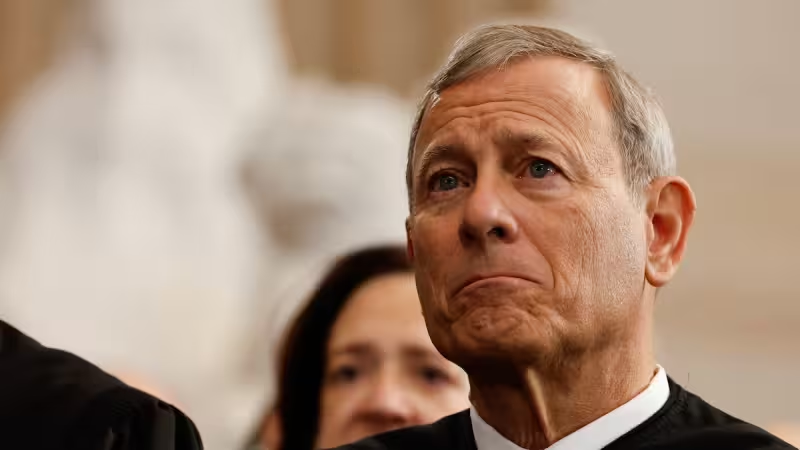
Brian Beutler says Democrats are kidding themselves if they think they can wait for a popular wave before moving against Supreme Court justices. In his telling, the same logic that pushed Democrats to confront Texas redistricting last year should now drive them to answer the court.
“To make reforms up to and including court expansion is going to require a level of public support or even public demand,” Beutler wrote, before rejecting the idea outright. “The urgency of court reform looks more like the urgency Democrats faced after Donald Trump ordered Texas to re-gerrymander its map last year.”
The point matters today because Beutler is arguing that Democrats do not need a national consensus to act; they need only the political will to respond to what he sees as repeated provocations from Republicans and their justices. He said there was no huge national clamor for state-by-state gerrymandering in 2025, and most people probably could not define gerrymandering if asked, but Democrats still had to answer Texas or accept second-class status in the two-party system.


That argument lands against the backdrop of a New York Times exposé on the beginnings of John Roberts’ shadow docket, which helped spark the discussion. Beutler said memos from 2016 showed Roberts weaponized the shadow docket and the major questions doctrine, and he tied the current reform debate to a broader liberal reaction that hardened after a series of Supreme Court fights.
He listed the theft of the Merrick Garland seat in 2016, the Amy Coney-Barrett power grab, the Clarence Thomas revelations, the Dobbs ruling and the presidential immunity ruling as moments that gave the liberal public a clearer sense of what was happening. In his view, that accumulated record is why the issue is no longer abstract.
Beutler said the idea of gerrymandering did not poll well in the abstract, but public response can change fast once people see a fight in motion. He said the same could happen with court reform if Democrats visibly push back, rather than waiting for permission from voters who have not yet been asked to care.
His warning was blunt: Democrats would doom themselves if they do not expand the court. And his larger answer to the question of whether the politics are ready is even starker. “Democrats can’t do this until it’s popular and there’s a large clamor for it,” he wrote, “but that is exactly why they will never do it unless they start now.”