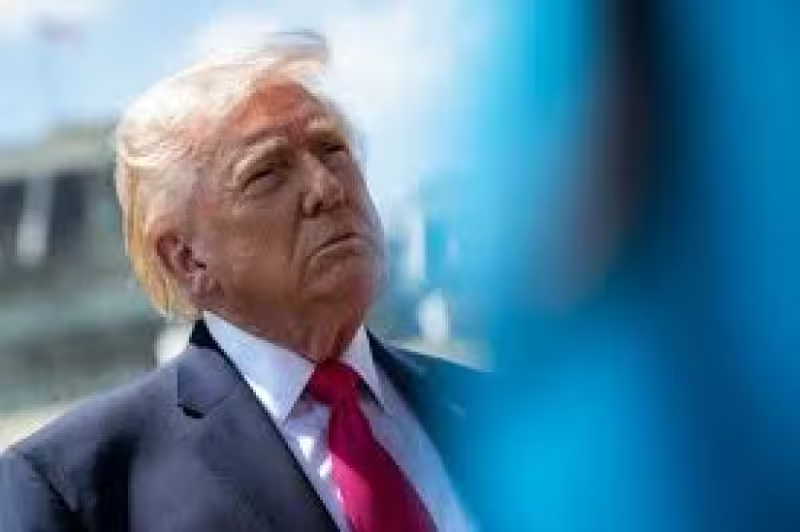
President Donald Trump said on Friday the United States would go into Iran and get all the nuclear dust, a remark that sharpened a dispute already circling around the fate of 970 pounds, or 440 kilograms, of enriched uranium believed to be buried under nuclear sites badly damaged by U.S. military strikes last year.
Iran’s deputy foreign minister, Saeed Khatibzadeh, said Tehran is not for a new round of face-to-face talks with the United States and said the Americans “have not abandoned their maximalist position.” The comments landed as Trump’s threat echoed through a standoff that has become more than a war of words: it is now tied to a material stockpile that both sides know is difficult to account for and harder to ignore.
The dispute comes against the backdrop of last year’s U.S. strikes on Iranian nuclear sites, which left the sites badly damaged but did not end questions about what remained buried below them. Trump’s reference on Friday was aimed at that unresolved uranium, and it came amid reported tensions over possible U.S.-Iran talks. The issue matters now because the discussion is no longer abstract diplomacy; it is about whether Washington and Tehran can even narrow the distance enough to sit down, let alone settle the nuclear file.
That distance was underscored late Saturday, when Mohammed Bagher Qalibaf said on state television that there would be no retreat in the field of diplomacy and that a wide gap remained between the sides. The remarks cut against any suggestion that the two governments were moving toward a breakthrough, even as their language stayed locked in the same hard line. Outside the talks, the Strait of Hormuz remained active on Saturday, April 18, 2026, where tankers were anchored off the coast of Qeshm Island, a reminder of how quickly the diplomatic fight can spill into a chokepoint watched far beyond Iran’s shores.
For now, the most important unanswered question is not whether the rhetoric is escalating. It is whether either side is still willing to step back from positions that make even the first face-to-face exchange look out of reach.