
Japanese authorities issued a tsunami warning after a powerful earthquake struck off the country’s north-east coast, with the shaking felt as far away as Tokyo. The Japan Meteorological Agency said the quake had a preliminary magnitude of 7.9.
NHK said authorities were checking the Onagawa nuclear power plant for any abnormalities after the quake, which it described as a 7.4-magnitude tremor at a depth of 10km in waters about 100km off the coast of Sanriku. The broadcaster also reported the quake registered an intensity of 5+ on Japan’s seismic scale of 0 to 7.
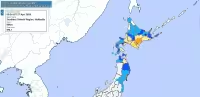
The warning covered large swathes of the northeastern coast, and NHK published a map showing tsunami advisories and warnings for parts of Hokkaido and Iwate prefecture. That mix of early readings and later field reporting reflects how fast Japan’s alert system moves when a japan earthquake threatens the shoreline: the first numbers go out quickly, then agencies refine what happened as they check the sea, the coast and critical infrastructure.
The immediate concern is no longer the shaking itself but what follows it. With warnings in place and plant checks under way, the next crucial question is whether the sea stays quiet long enough for coastal communities to stay safe.