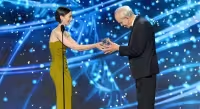
David Gross has spent much of his career chasing a question that still has no answer: whether gravity can be joined with the other three fundamental forces in one theory. In a recent conversation with Live Science, the Nobel Prize-winning physicist looked back on that long pursuit after receiving the $3 million Special Breakthrough Prize in Fundamental Physics.
Gross was 13 when he received a copy of The Evolution of Physics signed by Albert Einstein, the book that helped steer him toward a life in physics. Decades later, he became one of the scientists who helped explain whether quarks, the constituent parts of protons and neutrons, could be broken apart at all. Working with Frank Wilczek and H. David Politzer, he developed the principle of asymptotic freedom, which showed that the force between quarks weakens as they move close together and strengthens as they pull apart.

That idea became part of quantum chromodynamics, which helped unify the strong, weak and electromagnetic forces and completed the Standard Model of particle physics. Gross, Wilczek and Politzer won the Nobel Prize in Physics in 2004 for that work. The prize also put Gross in the company of a very small number of theorists whose ideas became part of the accepted structure of modern physics.
For the past few decades, Gross has turned to string theories in the hope that they might bring gravity into the same framework as the other three forces. He once led the Kavli Institute for Theoretical Physics at the University of California, Santa Barbara, and his recent prize has put that later chapter of his career back in the spotlight. The problem is not a lack of imagination or mathematics, but time: Live Science said the biggest barrier to a theory of quantum gravity is humanity's time left on Earth. That makes the search feel less like a distant puzzle than a race against the clock, and Gross remains one of the few physicists still pressing on it.