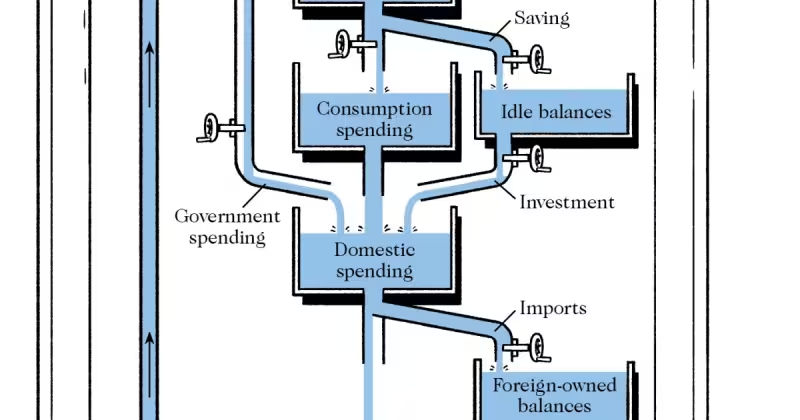
Bill Phillips once built a machine in his garage that looked more like a plumber’s prank than a piece of economic history. In 1949, he rigged water to flow back and forth between tubs and chambers, then told the London School of Economics it was a model of the British economy.
The stunt could have ended as a curiosity. Instead, it helped make Phillips one of the most influential economists of the postwar era, and it led to a job at LSE after he showed the model off there. The curve that bears his name is still central to economic discussions because it captured a fight economists were having after World War II: how to understand booms, busts, inflation and unemployment at the same time.
Phillips was not an academy man by birth or training. He was born in New Zealand and, before studying economics in London after World War II, hunted crocodiles, mined gold and worked as an electrical engineer. That unlikely path mattered because it gave him the practical instinct behind the machine. He was trying to show how one part of the economy could push on another, and how pressure in one place could show up somewhere else.
Read Also: Weather Miami: Flood watch posted as heavy rain threatens Central Florida



That was exactly the argument economists were wrestling with in the years after the Great Depression. John Maynard Keynes had suggested governments could prevent or at least moderate the wild swings of the business cycle. Phillips and other economists pushed the conversation further by linking inflation to unemployment. Their thinking was that when unemployment is low, workers have more bargaining power to demand raises, and those higher wages can feed a wage-price spiral that pushes up the cost of goods and services.
Richard Lipsey, who was there when Phillips demonstrated the water model at LSE, remembered the mood in the room as hostile. He said all the staff came out to humiliate “this upstart idiot.” But the scene turned quickly. After about ten minutes, Lipsey said, Phillips had proved he knew more than everybody there, and they shut up. That was the moment the garage invention became an intellectual weapon.
Read Also: Ashland High School Instruments Stolen Before Disney World Performance
The machine’s real lesson was simple enough to fit in a tank of water, but broad enough to last decades: economies move, and the forces inside them interact. That is why the Phillips Curve still matters. It remains a shorthand for one of the most enduring questions in macroeconomics — how much inflation a society will tolerate in exchange for lower unemployment, and whether that tradeoff even holds when policymakers try to manage it.
This excerpt from Planet Money: A Guide to the Economic Forces That Shape Your Life uses Phillips’ water model to explain the basics of macroeconomics, business cycles, inflation and unemployment. The odd machine built in 1949 did more than win attention at LSE. It gave economists a picture they have been arguing with ever since.