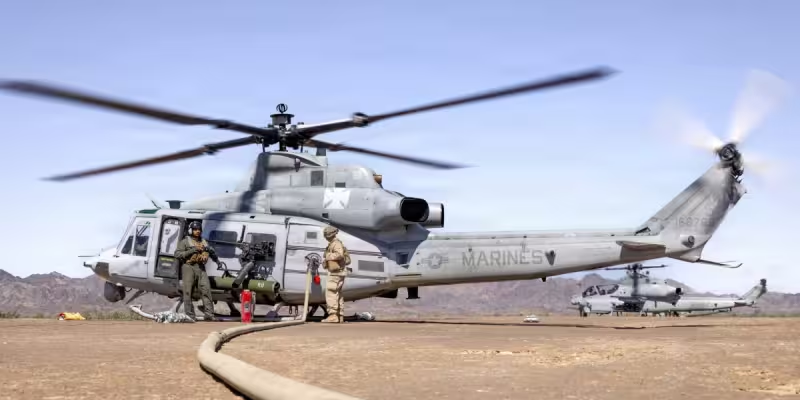
How Israeli Prime Minister netanyahu has reacted publicly is unclear, but the operation itself exposed how far U.S. forces went to recover a downed F-15 weapons system officer. Troops established a forward arming and refueling point (FARP) in a mountainous area near Isfahan to support a large, complex rescue mission.
A senior U.S. military official described the mission as one of the most difficult in recent special-operations history — complicated by steep terrain, the airman’s injuries and Iranian forces searching the area. Navy SEAL Team 6 commandos eventually reached the airman after he evaded capture for more than a day and climbed a roughly 7,000-foot ridgeline.
Extraction ran into trouble when two C-130 transport aircraft became stuck at the improvised airfield, delaying the withdrawal. Additional aircraft were flown in to get personnel out, and the U.S. destroyed the stranded C-130s to keep them from being captured. Imagery from the site also suggests other aircraft, including small helicopters, were left and later destroyed.
The rescue was completed with no additional U.S. casualties reported so far beyond the airman’s wounds. Still, the mission came amid the first combat losses of U.S. aircraft in the Iran campaign: an F-15 was shot down, and an A-10 providing close air support was damaged and later crashed after its pilot exited Iranian airspace.


Read Also: Trump Press Conference Follows Sunday Threat to Strike Iran
President Donald Trump has dismissed the threat posed by Iran’s air defenses even as he weighs larger options, including a potential ground operation to reopen the Strait of Hormuz. Gregory Brew, a Eurasia Group analyst, said the recent episode gives some idea of the capabilities and risks U.S. forces would face inside Iran.
Forward arming and refueling points aren’t new; they’re a long-standing part of U.S. military toolkit and forces routinely practice building them. Last month, Marine Aviation Weapons and Tactics Squadron One ran a seven-week FARP exercise at Marine Corps Air Station Yuma, and Marines also trained near the Chocolate Mountains on April 1.
On top of those preparations, units are moving into the region: the 31st Marine Expeditionary Unit recently arrived, the 11th MEU is en route, and paratroopers from the Army’s 82nd Airborne Division are deploying as well. With thousands of troops assembling, planners could consider operations to seize Kharg Island or other small islands near the Strait of Hormuz to blunt Iran’s control of key shipping lanes. For now, analysts say it’s still unclear whether the risky but successful rescue makes a larger ground assault more or less likely.