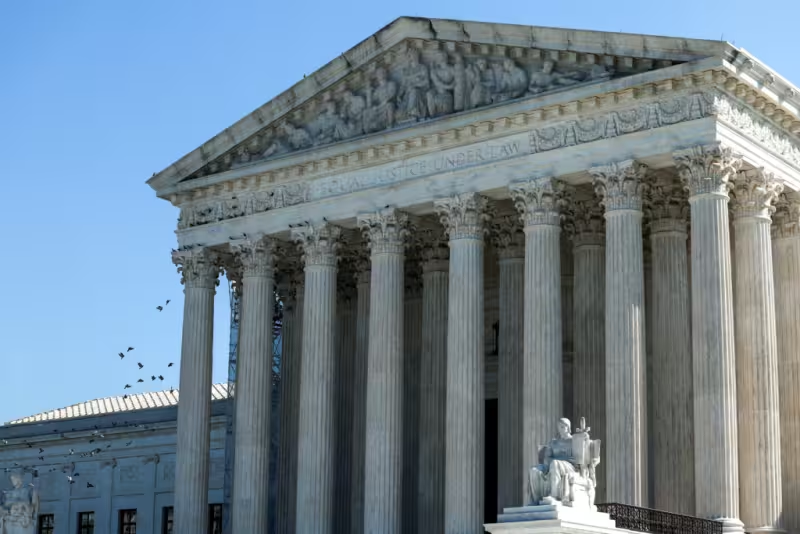
The Supreme Court was expected to issue opinions on its first opinion day in April, then move straight into a private conference that could send out orders Monday at 9:30 a.m. EDT. The court was also set to hear oral argument Monday in two cases, Sripetch v. SEC and T.M. v. University of Maryland Medical System Corp.
The timing matters because the justices are juggling a docket that has become a flashpoint inside the federal judiciary even as the emergency docket has lightened considerably this year. That tension hung over the week as Justice Clarence Thomas used a University of Texas Austin Law School event tied to America’s founding 250 years ago to argue that “Progressivism seeks to replace the basic premises of the Declaration of Independence and hence our form of government,” and to say Washington has been overrun by officials who lack commitment to “righteous cause, to traditional morality, to national defense, to free enterprise, to religious piety or to the original meaning of the Constitution.”

On the same day, Sen. Ted Cruz said in a Opinion Live interview that President Trump had spoken to him seriously in his first term about hypothetical Supreme Court vacancies. Cruz said he turned the idea down three times because he did not want to leave political combat, adding that “a principled federal judge stays out of policy fights and stays out of political fights.”
Separately, the financial stakes from the court’s tariff work also remain unresolved. Customs and Border Protection told the Court of International Trade in a Tuesday filing that the vast majority of importers who paid $166 billion in tariffs later overturned by the Supreme Court may not get refunds because they have not signed up for electronic payment. reported that only about 20% of the roughly 300,000 firms eligible for electronic refunds had enrolled, leaving a large share of the money in limbo.
That mix of impending opinions, procedural orders and unfinished fallout is why the court’s work this week is more than a calendar note. It is a reminder that even when the justices are not handing down a blockbuster, their decisions and the machinery around them still shape how federal power, money and politics move next.