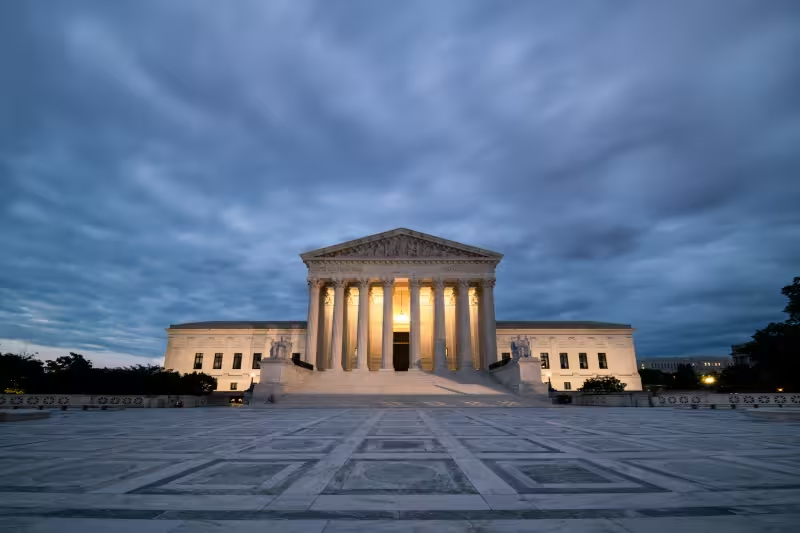
The argument in Trump v. Barbara turned quickly to a question that has shadowed birthright citizenship for more than a century: whether the exceptions to it are fixed or can be expanded. Cecillia Wang repeatedly pressed that the exceptions are a closed set, pointing to the children of ambassadors, tribal Indians and invading armies as the only categories the 14th Amendment left outside the rule.
That framing mattered because the exceptions, Wang argued, were set in 1868 when the 14th Amendment was adopted. Her point was not just about history. It was about whether the Constitution can be read as a living document or treated as if it were frozen at the moment of adoption.
The exchange echoed a line of reasoning the supreme court of the united states has already embraced in another area of constitutional law. Since District of Columbia v. Heller in 2008, the court has taken a distinctly originalist approach to the Second Amendment. And in New York State Rifle & Pistol Association v. Bruen in 2022, the justices clarified that Second Amendment cases proceed in two stages: first, courts ask whether the plaintiff’s conduct is covered by the plain text of the amendment; then the government must show that the challenged regulation fits the nation’s history of firearm regulation.

That approach, as the court has used it, does not mean the Second Amendment is locked to 18th-century technology. The article says semiautomatic firearms did not exist at the Founding, and the court rejected as bordering on the frivolous the idea that only weapons in existence in the 18th century are protected. It has said semiautomatic handguns qualify as Arms under the amendment’s plain text, while also explaining in Heller that Americans do not have an unlimited right to keep and carry any weapon whatsoever.
The same doctrine draws a line between ordinary weapons and those the government may regulate. The court has reasoned that dangerous and unusual weapons can be restricted, but weapons in common use cannot be banned. That distinction is part of the broader logic Wang appeared to invoke: if the court can read the Second Amendment in light of history without freezing it in time, then the citizenship clause should not be treated as trapped in amber either.
The tension in the argument is that the historical record cuts both ways. On one hand, the 1868 exceptions Wang described are narrow and specific. On the other, the court’s modern originalist method has shown a willingness to adapt constitutional text to things the Founders never knew. The result is a debate over whether the justices will treat birthright citizenship the way they have treated gun rights: as rooted in history, but not limited to the exact world that created it.
What happens next will turn on whether the justices accept that the exceptions to birthright citizenship really are closed, or whether they see room to read the clause more expansively. For now, Wang’s argument left little doubt about her answer: the list was fixed in 1868, and the court should not rewrite it now.