Donald Trump has tied himself to UFO disclosure in 2026, putting the White House on a timeline that has no obvious precedent in modern Washington. The move follows his directive in February for departments to release government files related to alien and extraterrestrial life, and it comes after the White House registered aliens.gov in March.
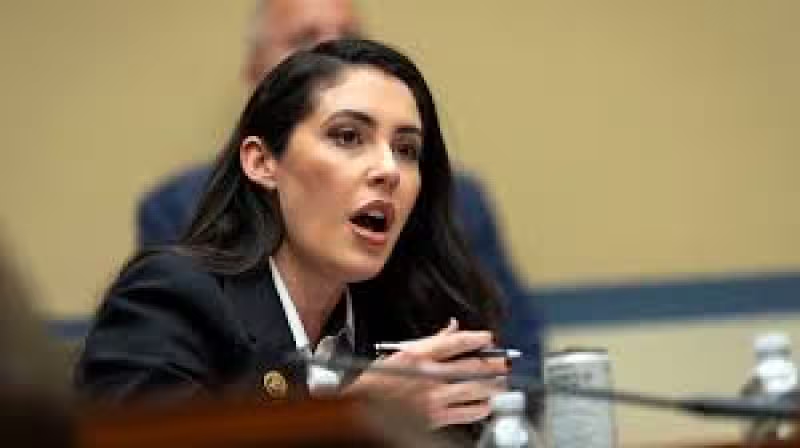
The shift is being watched closely by Anna Paulina Luna and others who have helped move the subject from the fringe into the political mainstream. JD Vance has said he is obsessed with UFOs, though he also believes they are demons rather than aliens, and Donald Trump Jr. said last year that there was evidence of non-human intelligence out there engaging with our planet.
That is a remarkable posture for a Republican administration, especially one that is now making room for disclosure talk in public. The Department of Defense has said it plans to release never-before-seen UAP information, adding official weight to a topic that has usually been treated as speculation, ridicule or both.

The backdrop is a debate that has been running for years inside and outside government. In 2023, David Grusch testified to Congress that the U.S. had operated a multi-decade program that collected and attempted to reverse-engineer crashed UFOs, while the government said it had not operated such a program. Last week, Tim Burchett used an interview to proclaim that we are not alone.
Stephen Bassett, a longtime disclosure advocate, said the moment is unlike anything he has seen. “We’ve never been closer to disclosure,” he said, calling the situation “unprecedented” and “ripe” for action. Bassett said the president of the United States is now in a position where he could do this tomorrow, and that Trump could set up for a quick press conference out of the Oval Office and confirm in a few minutes that we’re not alone.
That is the tension inside the administration’s approach: public openness is rising, but the evidence itself remains under wraps. Tulsi Gabbard said last year that she believes in the possibility of extraterrestrials, yet the White House did not respond to a request for comment, leaving the biggest claims about the subject still waiting for the federal government to either substantiate them or shut them down.
For now, the most important fact is not that Washington is talking about UFOs again. It is that Trump has attached a deadline to disclosure, and the people around him are treating the question as something that could be answered from the Oval Office, not just buried in classified files. If that happens, the political cost — or the huge legacy — would belong to him first.