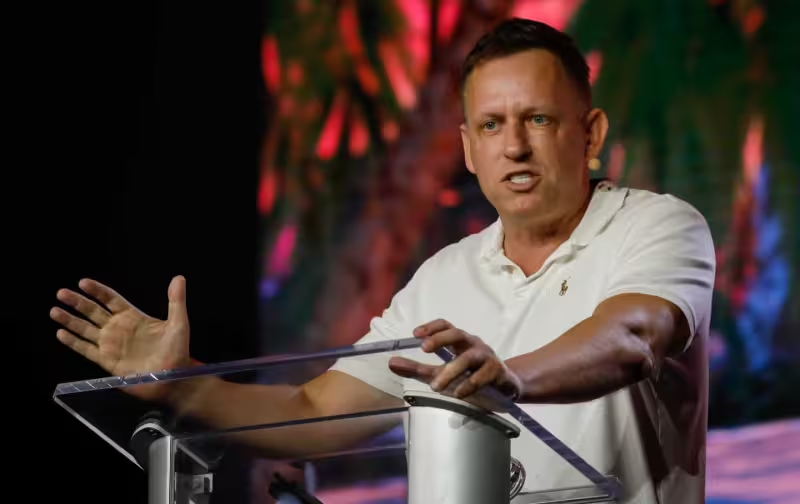
Silicon Valley would not exist without government-funded research, and some of its loudest billionaire critics now want to tear down the institutions that made it possible. Peter Thiel and Marc Andreessen, two conservative venture capitalists with close ties to President Donald Trump, have turned their fire on universities and institutional science even as the technologies that made their fortunes grew out of public research money.
The pattern runs through the whole industry. The semiconductor and the Internet emerged from Cold War-era military research programs. Larry Page and Sergey Brin relied on National Science Foundation funding while they were graduate students at Stanford to build the search algorithms that became Google. The touchscreens and lithium-ion batteries people carry around all day came out of university labs funded by government grants, and generative AI grew from decades of research underwritten by the Department of Defense.
That history matters today because the fight is not abstract. Public science funding is under assault during the Trump administration, and the central institutions in the crossfire are the National Science Foundation and DARPA, the Pentagon-backed research agency that helped seed both older technologies and the AI boom. The argument being made by Thiel and Andreessen is not simply that universities are inefficient. It is that they are obstacles to innovation itself, even though innovation in Silicon Valley has repeatedly depended on them.


Andreessen laid out that case in leaked private text messages last year, writing that universities were “at Ground Zero of the counterattack.” He described Stanford and MIT as “mainly political lobbying operations fighting American innovation at this point” and said they would “pay the price” after declaring war on 70% of the country. He also called for the National Science Foundation to receive “the bureaucratic death penalty.”
Thiel has made a similar argument in numerous interviews, saying there are 100 times as many science PhDs as there were a century ago but that the rate of progress is about the same. He put it more bluntly in a line that has become central to his critique of academia: “The average PhD is 99% less productive than people were 100 years ago.” He has acknowledged that DARPA worked well early on, but has decided that it was a one-time acceleration, not a model to repeat.
The contradiction is hard to miss. Geoffrey Hinton left his academic position in the United States because he wanted to avoid Pentagon contracts, then turned to the Canadian government to help fund his lab at the University of Toronto, which went on to produce leading AI researchers for OpenAI, Google and Meta. The same public research system now being attacked supplied the people and ideas that helped build the companies in question.
What comes next is whether the money, labs and graduate programs that fed decades of American technological leadership can survive a political turn that treats them less as national assets than as enemies. If they are weakened, the damage will not show up only in universities. It will land in the next generation of chips, software and AI systems before most Americans notice the ground has shifted.