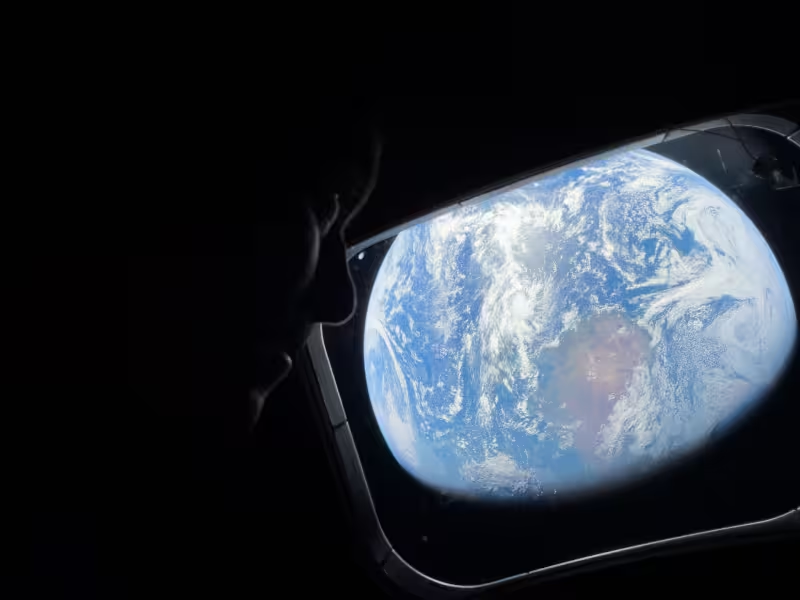
Four astronauts are now flying the first crewed test flight under NASA’s Artemis program, with Reid Wiseman, Victor Glover, Christina Koch and Jeremy Hansen aboard Orion after lifting off from launch pad 39B at Kennedy Space Center in Florida at 6:35 p.m. EDT on April 1.
The Artemis II mission is scheduled to last about 10 days and end with a splashdown off the coast of San Diego at approximately 8:07 p.m. EDT on Friday, April 10. NASA says the crew is expected to travel 695,081 miles from launch to splashdown, while Orion swings within 4,070 miles of the lunar surface and reaches a maximum distance of 252,760 miles from Earth, about 4,105 miles farther than Apollo 13.
The flight is the first crewed test of the spacecraft that NASA wants to send deeper into the Moon program, and it is being used to push Orion through planned checks in open space rather than in simulation. Wiseman, Glover, Koch and Hansen are expected to fly the spacecraft manually at points, monitor automated operations and evaluate life-support, propulsion, power, thermal and navigation systems as they go.

Read Also: Apollo 11 echoes as NASA stands behind Artemis 2 heat shield
That makes the mission more than a ceremonial loop around the Moon. The astronauts will also carry out proximity operations, assess habitability and crew interfaces, and take part in science activities that include lunar surface observations. NASA is asking whether Orion and its systems can handle the demands of deep space with people on board, and this flight is designed to answer that before the program goes farther.
Read Also: Artemis Photos show Earthset, eclipse and moon’s far side in rare flyby
After splashdown, recovery teams will retrieve the crew by helicopter and deliver them to the USS John P. Murtha for medical checks before they return to shore and fly back to NASA’s Johnson Space Center in Houston. The mission’s next step is not a new announcement or a distant future date. It is the test data, and whether Orion performs the way NASA needs it to when the Moon comes back into view for real.