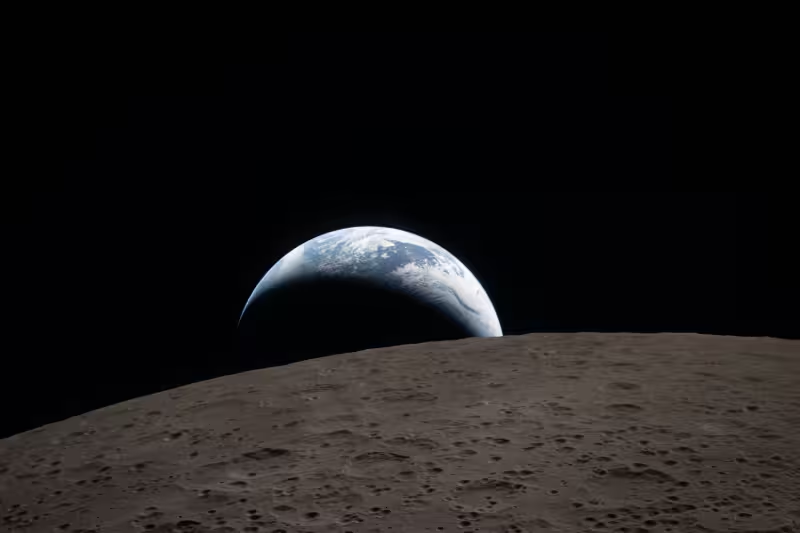
Four astronauts flew around the moon on Monday during Artemis II, spending about seven hours circling the lunar surface while taking photographs and making observations that NASA says have already produced a haul of striking images. The White House shared the first photo from the flyby on Tuesday morning on X, and it showed Earthset as Earth slipped out of view on the far edge of the moon.
NASA astronauts Reid Wiseman, Victor Glover and Christina Koch and Canadian astronaut Jeremy Hansen captured the artemis photos from the window of Orion, including one image that showed a darkened moon with the sun’s corona glowing around its edge during a solar eclipse on Monday evening. The crew became the first people to view an eclipse from the moon, and the first people to see the entire lunar far side during a mission that included 30 science targets.
Glover, looking out at the lunar boundary between light and darkness, said, “Boy, I am loving the terminator.” He added that there was “so much magic” in the terminator, describing islands of light and valleys that “look like black holes.” Koch said the smaller impact craters looked “like a lampshade with tiny pinprick holes” and noted that “they’re so bright compared to the rest of the moon.”
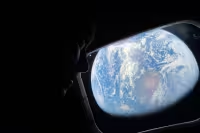
Read Also: Apple Iphone 17: NASA astronauts use iPhone 17 Pro Max to photograph Earth on Artemis II
The sightlines mattered because the moon’s far side is never visible from Earth, which always faces the same lunar hemisphere, and even Apollo astronauts did not get much of a view of it because of the paths and timing of their flights. One of Artemis II’s science targets was the Orientale basin, a crater nearly 600 miles wide and 3.8 billion years old that straddles the moon’s near and far sides, giving the crew a rare look at terrain tied to the earliest history of the solar system.
That makes the first released image more than a postcard. It is a reminder that Artemis II is not only testing the spacecraft and the crew’s endurance on a lunar loop, but also opening a perspective on the moon that only a handful of people have ever had, and none before this mission had seen in full.