
The Artemis II astronauts are now more than halfway to the moon, and for the first crew to make that journey in more than 50 years, the view finally changed. Christina Koch, Reid Wiseman, Victor Glover and Jeremy Hansen caught their first glimpses of the lunar far side after launching Wednesday on a 10-day trip around the moon.
Koch said the scene looked wrong in a way that was hard to put into Earth language. The moon’s darker stretches were not where her mind expected them to be, she said, and the sight felt unlike anything she had ever seen. The crew compared what they were seeing with their study materials as they tried to make sense of a landscape that had only existed for them in images and simulations until now.
That mattered because the mission has already crossed a key threshold. The astronauts lifted off aboard NASA’s Space Launch System rocket and Orion capsule, becoming the first humans to leave Earth in a lunar mission since the Apollo era. A key engine burn Thursday evening pushed Orion out of Earth’s orbit, and Reid Wiseman later called the flight a magnificent accomplishment. From the spacecraft, he said, the Earth and moon together made for a truly awe-inspiring view.
Read Also: Artemis Photos show Earthset, eclipse and moon’s far side in rare flyby
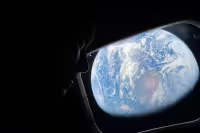
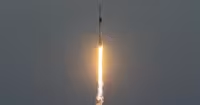
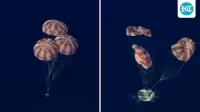
The trip has not been all spectacle. The four astronauts began testing life-support systems in the first hours after liftoff, then had to work through email glitches and problems with the onboard space toilet. Koch said they have still been able to rest and sleep comfortably inside the 16.5-foot-wide Orion capsule, which has a habitable volume roughly equivalent to a camper van. They also spoke with their families on Friday and Saturday, a reminder that even on a mission built around lunar firsts, they are still, as Koch put it, just people trying to get by.
The tension in the flight is that the moon they are approaching is not the one most people know from Earth. The far side is never visible from our planet because it always faces away, and even Apollo astronauts could not see much of it because of their flight paths and timing. Koch said that made the moment feel almost disorienting: “That is the dark side. That is something we have never seen before.”
Read Also: Apple Iphone 17: NASA astronauts use iPhone 17 Pro Max to photograph Earth on Artemis II
The crew is expected to enter the lunar sphere of influence at 12:41 a.m. ET Monday, with the flyby set for later that day. For now, the mission is doing what it was designed to do: prove that humans can travel this route again, and let the astronauts see a place that has stayed hidden from Earth for as long as people have been looking up.