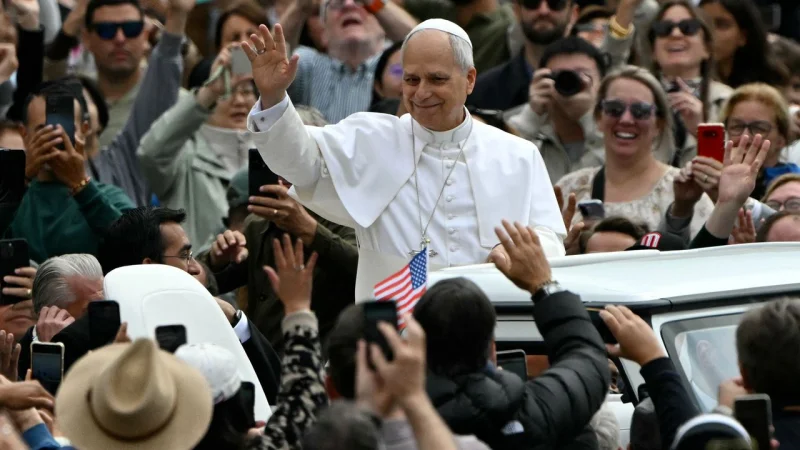
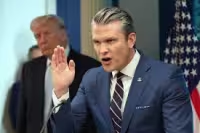
Pope Leo XIV is being pressed into global politics less than a year after his election, as the Vatican granted an audience to Marco Rubio on Thursday and Washington said the secretary would discuss the Middle East and U.S. interests in the Western Hemisphere with Holy See leadership.
The meeting came after President Donald Trump said last Friday, “We will be taking over almost immediately,” a line that sharpened attention on how the new pope, elected on May 8, 2025, may respond when the United States and the Vatican find themselves looking at the same crisis from different ends of the table.
That matters because Leo is not just any new pontiff. Robert Prevost became the first American pope when he was elected, a Chicago-born, Peruvian citizen, and he is seventy years old. He is also an Augustinian friar who, by reputation and instinct, has spent much of his life outside the glare that once surrounded the papacy. He likes to play tennis at a Vatican palace in Castel Gandolfo, in the hills southeast of Rome. Until his election, even many church watchers knew little about his missionary work and order leadership.
The Rubio audience was described by the State Department as a chance to talk about the Middle East and mutual interests in the Western Hemisphere, and advance reports suggested Cuba would come up as well. The department’s readout said the audience underscored the strong relationship between the United States and the Holy See and their shared commitment to promoting peace and human dignity. That language was polished, but the timing was not accidental. Trump has launched his war of choice against Iran in February, and the administration has every reason to keep one eye on Catholic voters, another on the wider geopolitical leverage that still flows through Rome.
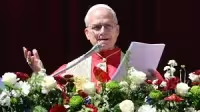
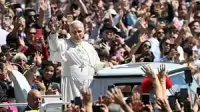
The Vatican also has history on its side, or at least within reach. On June 2, 1979, John Paul II began an apostolic journey to Poland that drew six million people in a country of thirty-five million. He was the first Polish pope and the first non-Italian pope in more than four hundred years, and his visit was a political earthquake as much as a religious one. A contemporary account said he had “made himself a totally novel and incalculable element in future East-West relations.”
That is the comparison now hanging over Leo’s first year: whether an American pope can become, in his own way, a force in geopolitics. John Paul II told Poles that he “wishes to express the full sovereignty of the nation,” and warned that “Christ will never approve” of the forces then squeezing the country. Leo has not spoken in that register, at least not yet. But the Rubio visit shows how quickly a pope’s calendar can become a map of the world’s anxieties.
There is also a harder edge to the timing in Washington. The advance talk about Cuba, the effort to reach Catholics before the midterm elections and the possibility of sharpening rivalry between Rubio and J. D. Vance all point to a papal audience that may matter well beyond church diplomacy. For now, Leo is being treated not just as a spiritual leader but as a player whose silence, or words, could echo far outside the Vatican walls.
The question is no longer whether the first American pope will be drawn into U.S. power politics. It is how soon he will have to decide whether that pull is a tool, a trap or both.