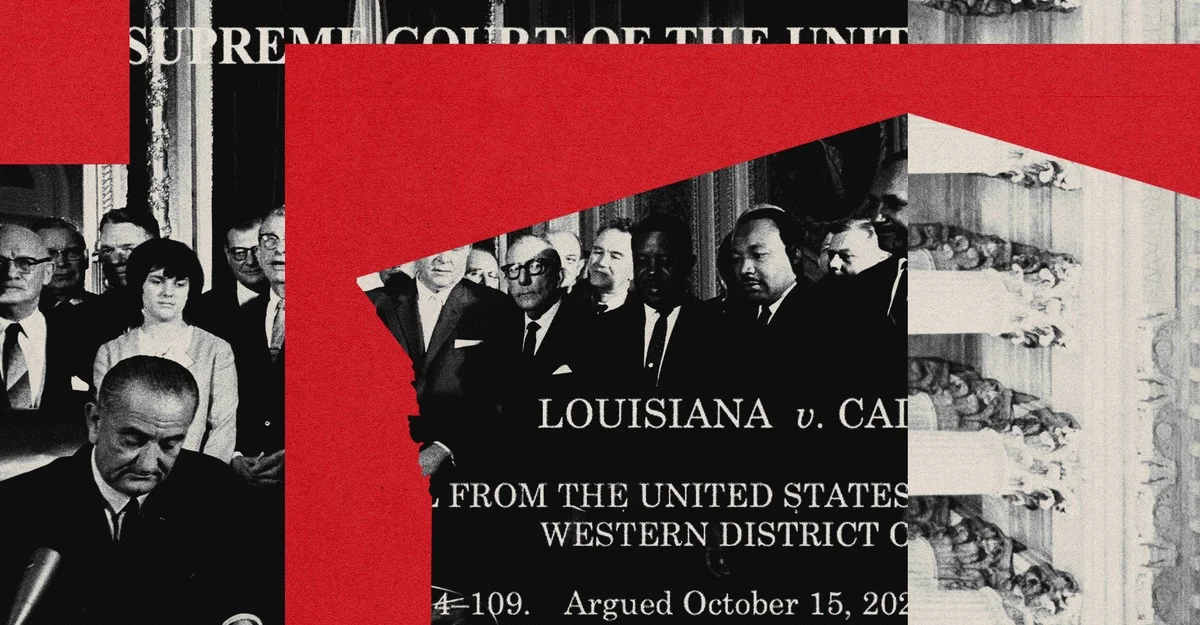
The Supreme Court’s conservative majority on Wednesday morning sharply limited the use of race in drawing congressional districts, handing down a ruling in Louisiana v. Callais that also made it harder for minority groups to challenge maps they say are discriminatory. Justice Samuel Alito wrote for the majority that race can be considered only when “present-day intentional racial discrimination regarding voting” can be proved.
The decision did not strike down the Voting Rights Act, but it cut deep into the law’s practical reach. The article describes it as the court’s conservative majority completing a 13-year campaign against the statute, which was enacted in 1965 to protect Black suffrage by neutralizing voter suppression in southern states. For decades, it became the foundation for equal ballot access for all Americans. After Wednesday’s ruling, the article says, only the facade of those protections remains.


The case was a sequel to Robinson v. Landry, filed in 2022 by Black plaintiffs who challenged a new congressional map passed by the Republican-controlled Louisiana state legislature. Louisiana has six House members, and one third of its residents are Black, but the map packed Black residents along a corridor from Baton Rouge to New Orleans into a single district while breaking up Black communities elsewhere. No other district came close to a Black majority. The Robinson plaintiffs argued that the plan illegally gerrymandered Black voters by essentially halving their voting strength, and the accepted court plan created a second Black-majority district by connecting predominantly Black neighborhoods.
That fight landed in a state where voting is intensely polarized along racial lines, with white voters generally supporting the opponents of whomever Black voters back. That reality is why the ruling matters so much now. By narrowing when race can be used and making it harder to bring challenges, the court left the Voting Rights Act with little more than a shell in the places where it has mattered most. The law is dead in the South, and the next battles over congressional maps will be fought with far less protection than the one that was supposed to guard them.
“Present-day intentional racial discrimination regarding voting” is now the narrow doorway the court says remains. For everyone trying to stop discriminatory maps, that door is almost shut.