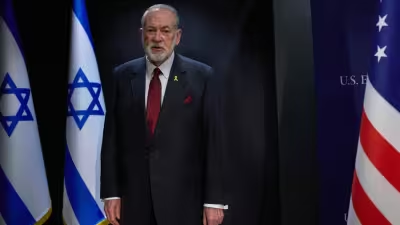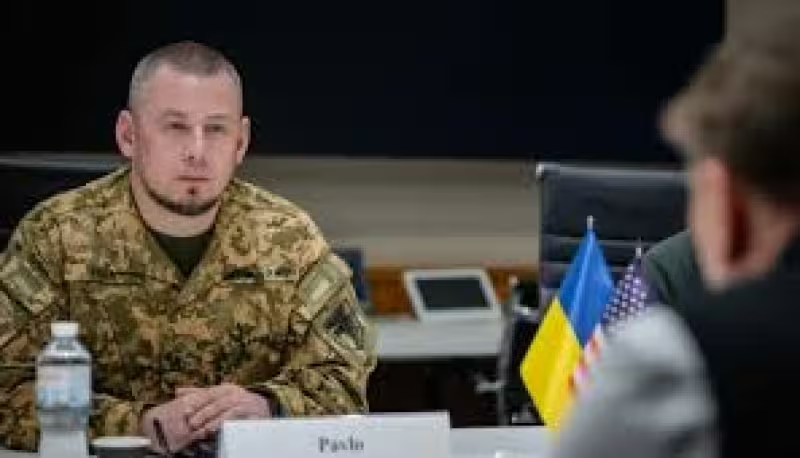
cia director David Petraeus has made 10 trips to Ukraine since Russia's 2022 invasion. On a recent visit to Kyiv, after watching units near the frontlines, he said Russia "no longer has the upper hand."
Petraeus said that over the last two months Ukrainian forces have actually made greater incremental gains than the Russians — a surprise given Moscow’s advantages in manpower, firepower and economic scale.
He credits much of the change to Ukraine’s improvisation with unmanned systems. The drones themselves matter, he said, but the real advantage is the network built around them.
An engineer familiar with the technology described that network as a sort of "military Google maps": a digital display of positions, targets and other relevant data. At the center is Ukraine’s Delta battle management platform, which ties surveillance, targeting and strike capabilities into one command-and-control ecosystem.
That integration gives Ukrainian forces near‑absolute surveillance and strike reach within roughly 20 miles of the frontline. Petraeus described watching an engagement in which rotating surveillance drones tracked a Russian soldier continuously before attack drones were launched.


"Once you’re observed on this battlefield and you can’t get into a deeply buried position really quickly, it’s not going to end well," he said.
Ukraine is also scaling production of low-cost first‑person‑view drones at a pace far beyond Western militaries. One manufacturer Petraeus visited told him it plans to make three million drones this year, compared with roughly 300,000 produced by the United States last year.
He noted that electronic warfare still constrains operations inside that roughly 20‑mile zone, where adversaries jam links between pilots and their platforms. Engineers have experimented with fiber‑optic, tethered drones to avoid jamming, but range and cable supply impose limits.
Petraeus said algorithms will be the next game changer. "What's coming is going to be algorithmically piloted drones that you can't jam," he said, explaining that reducing reliance on GPS could let these systems operate even in heavily contested electronic environments and allow one operator to control multiple aircraft.
He added that fully autonomous systems — with humans defining missions and machines executing them — may arrive soon. "I think that will be possible within a couple of years, and we may well see it first here," Petraeus said.
For Petraeus, the lessons for the United States go beyond buying more airframes. He argues the bigger challenge is reorganizing command and control so those tools actually change how battles are fought, rather than simply adding new capabilities to old structures.