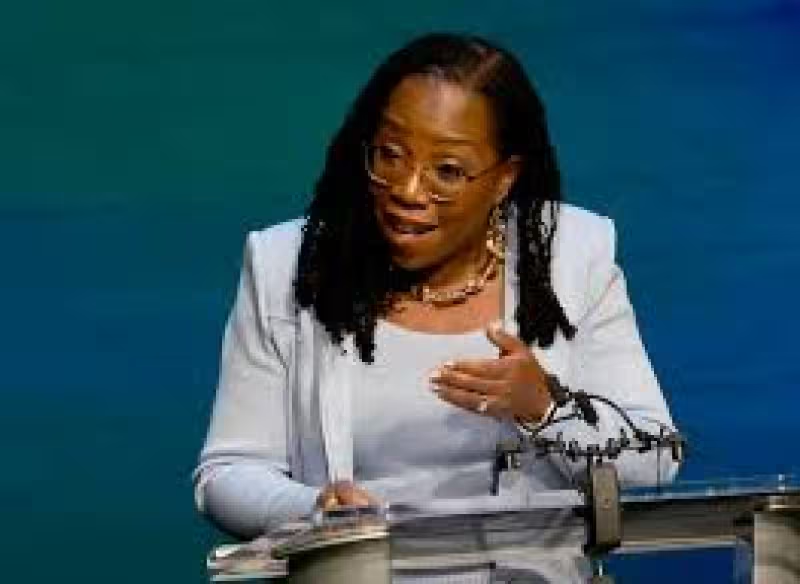
Justice Ketanji Brown Jackson said the Supreme Court’s emergency orders have been used to help Donald Trump push through controversial policies, sharply criticizing her conservative colleagues for acting on what she called “scratch-paper musings” that can “seem oblivious and thus ring hollow.”
Jackson spoke for nearly an hour on Monday at Yale Law School, and the school posted a video of the event on Wednesday. In that appearance, she revisited roughly two dozen court orders issued last year that allowed Trump to advance immigration measures, steep federal funding cuts and other policies after lower courts had found they were probably illegal.
The critique landed squarely at the center of the Supreme Court’s emergency docket, the fast-track lane the nine-member bench uses when lower-court cases are still pending and the justices are asked to act without hearing full oral arguments. Under the second Trump administration, the court has received 34 emergency applications and has sided with Trump in most of them, giving the president a legal advantage while the underlying disputes continue to move through the courts.
Jackson’s comments were not new in substance. She has raised the same objections in dissenting opinions and did so again in an unusual appearance with Justice Brett Kavanaugh last month. But her Yale remarks were unusually direct. She said the emergency orders are often issued with little or no explanation and amount to “back-of-the-envelope, first-blush impressions of the merits of the legal issue,” even though lower courts are then expected to apply those “scratch-paper musings” in other cases.


She argued that the orders also gloss over the people affected by them. Jackson rejected the court’s view that blocking a president from carrying out a policy is itself a harm that can outweigh the harm faced by challengers. “The president of the United States, though he may be harmed in an abstract way, he certainly isn’t harmed if what he wants to do is illegal,” she said.
The justice also placed the current fight in a broader institutional frame. She said the court used to be reluctant to step in this early in a case and that there is value in avoiding constant intervention in the most divisive issues in American life. “In recent years, the supreme court has taken a decidedly different approach to addressing emergency stay applications. It has been noticeably less restrained, especially with respect to pending cases that involve controversial matters,” she said.
That critique now sits alongside similar warnings from other liberal justices. Sonia Sotomayor also spoke about emergency orders last week at the University of Alabama, underscoring that the court’s fast-moving shadow docket has become a point of open tension inside the nine-member bench. Jackson’s argument is more than a procedural complaint: it is a challenge to how the court measures urgency, fairness and the real-world consequences of intervening before a case has been fully argued.
For now, the pattern remains unchanged. The Supreme Court has repeatedly moved quickly when Trump asks it to step in, and Jackson is signaling that she believes those decisions are becoming more consequential, more frequent and less candid about their effects. The next test is not whether the criticism will continue. It is whether the court is willing to explain why it keeps choosing speed over restraint.