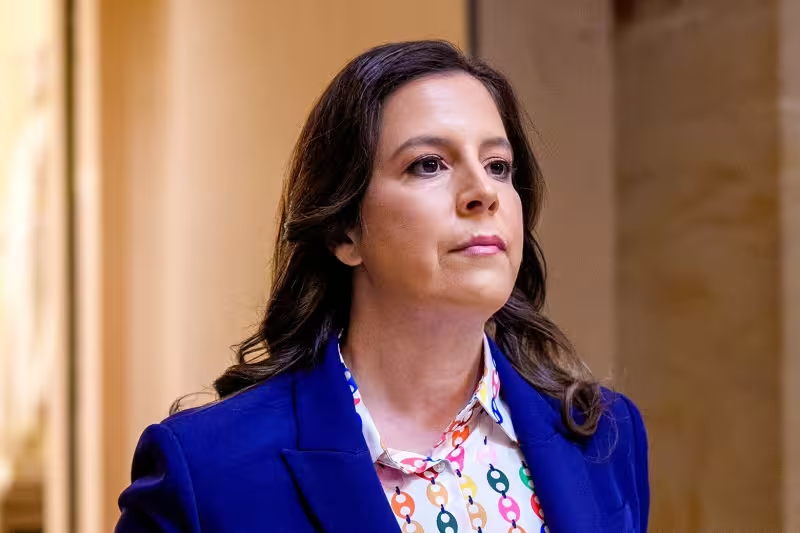
Elise Stefanik says the congressional hearing that helped turn her into one of the most recognizable Republicans in America almost did not happen. In her new book, Poisoned Ivies: The Inside Account of the Academic and Moral Rot at America’s Elite Universities, the New York representative writes that she was sick on the day she questioned the presidents of Harvard, MIT and Penn in late 2023, and nearly gave up her time before deciding to go to work anyway.
Stefanik said she showed up armed with Kleenex, cough drops and over-the-counter cold medicine, and described the decision to yield her minutes as nearly not happening. “The question heard around the world almost didn’t happen,” she says in the book, a line that captures how a testy committee exchange over campus antisemitism became one of the defining political moments of 2023.
The hearing became so embedded in the political culture that it later turned up on Saturday Night Live, which Stefanik dismissed as “the worst cold open ever.” The moment mattered because it pushed her far beyond the niche world of House politics and into the center of a national fight over antisemitism, elite universities and the wider campus response to the war in Gaza.


That broader debate is where Poisoned Ivies draws its sharpest lines. The book avoids describing any aspect of what was occurring in Gaza, characterizes the Jewish campus response without noting that many Jewish students and faculty publicly said they opposed the war, and recounts the occupation of Hamilton Hall at Columbia without telling the story of Hind Rajab, whose name the occupiers used to rename the building. Those omissions matter because they show the book’s frame: a political memoir built around the hearings rather than a full account of the conflict feeding the protests.
Stefanik’s own political evolution is part of that frame. She had once been a moderate Republican and a Harvard graduate, but by the Joe Biden years she had gone full MAGA and made statements backing Donald Trump’s false claims about the 2020 election. Trump nominated her to be ambassador to the United Nations in early 2025, then withdrew the nomination because he did not want to risk losing her House seat in a special election. He also declined to endorse her run for the Republican nomination for governor of New York.
In December of last year, Stefanik suspended that gubernatorial campaign and said she would leave Congress at the end of her term in 2026. She has a 4-year-old son and said she would be spending time with him. For now, she has not hinted at a return to public life, leaving Poisoned Ivies as both a recapitulation of her rise and a marker of how quickly that rise was interrupted.
The book’s value is not that it explains every piece of the campus antisemitism fight. It is that it confirms how much of Stefanik’s political brand now rests on one hearing, one viral line and one moment that nearly never happened.