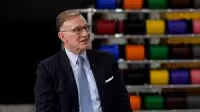
D-Wave Quantum shares jumped nearly 16% on Tuesday after Chief Executive Alan Baratz used a World Economy Summit appearance to take direct aim at Nvidia and pitch his company’s machines as the real deal in quantum computing. “If I was Nvidia, I'd be shaking in my boots,” Baratz told Yahoo Finance at the Semafor World Economy Summit, arguing that D-Wave’s hardware and software can already do work that would overwhelm conventional chips.
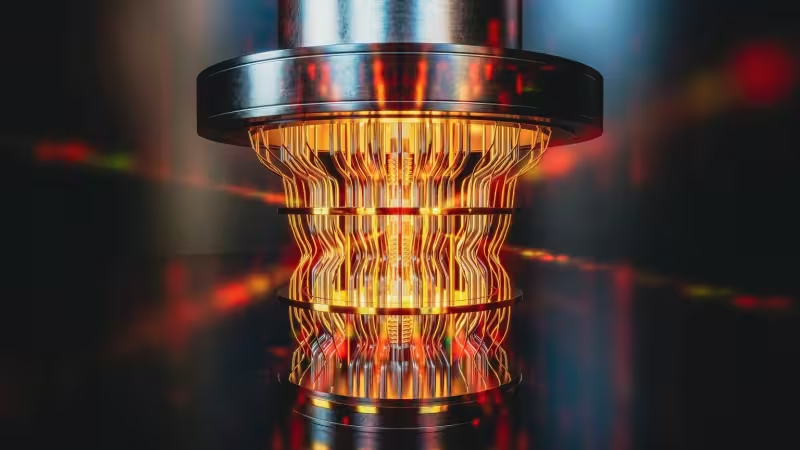
Baratz said D-Wave’s quantum computer takes about 10 kilowatts of power to run, roughly the draw of five to 10 GPUs, and said a problem his system could solve in minutes would take a massive GPU setup nearly 1 million years and the world’s power to finish. The comments landed on April 14, World Quantum Day, and came as the stock extended a rally that has lifted it roughly 140% over the last year, even after a 3% slide in the past 30 days. IonQ also rose 18% Tuesday after saying it had scaled its commercial systems beyond a single processor.
The surge gives new life to a name that remains a favorite among speculative traders, but the numbers still show a company trying to prove that its promise can translate into durable business. D-Wave reported $2.75 million in revenue in Q4 2025, up 19% from a year earlier but below analyst estimates of $3.8 million. It posted an adjusted net loss of $0.09 per share, wider than the $0.05 loss analysts expected, even as bookings hit $13.4 million, up 471% from the prior quarter.

That mix of fast growth and thin sales has not stopped Wall Street from leaning in. Wedbush analyst Antoine Legault said D-Wave has a customer base of over 135 clients and kept an Outperform rating with a $40 price target, while Canaccord Genuity’s Kingsley Crane assigned a $43 target and said the pipeline is stronger than ever. Crane called QBTS a long-term concept stock trading at 150x projected 2027 sales and said investors should accept that near-term volatility comes with the territory. His bull case points to a $75 pathway.
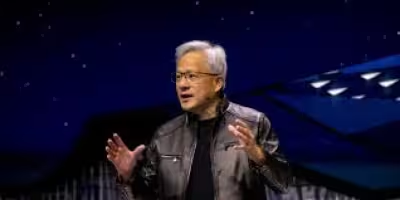
Baratz’s pitch also arrives as Nvidia moves deeper into the field with Ising, a family of open-source quantum AI models for error correction, and as Jensen Huang says AI is essential to making quantum computing practical. That underlines the split in the market: quantum systems are still specialized tools, unable to run large language models, and most developers still rely on traditional chips because quantum hardware remains unstable and prone to errors. D-Wave is trying to answer that skepticism with contracts and scale, including a $20 million agreement with Florida Atlantic University and a collaboration with Anduril Industries and Davidson Technologies on U.S. air and missile defense applications.
The company’s path has also been shaped by years of expensive bets, including a $550 million acquisition of Quantum Circuits, and by a history that reaches back to 2011, when it sold its first commercial system to Lockheed Martin. With a market value of $5.3 billion, D-Wave is no longer an experiment traded on pure hope. The question now is whether bookings, contracts and headline-grabbing physics can keep outrunning the revenue line investors are still waiting to see catch up.