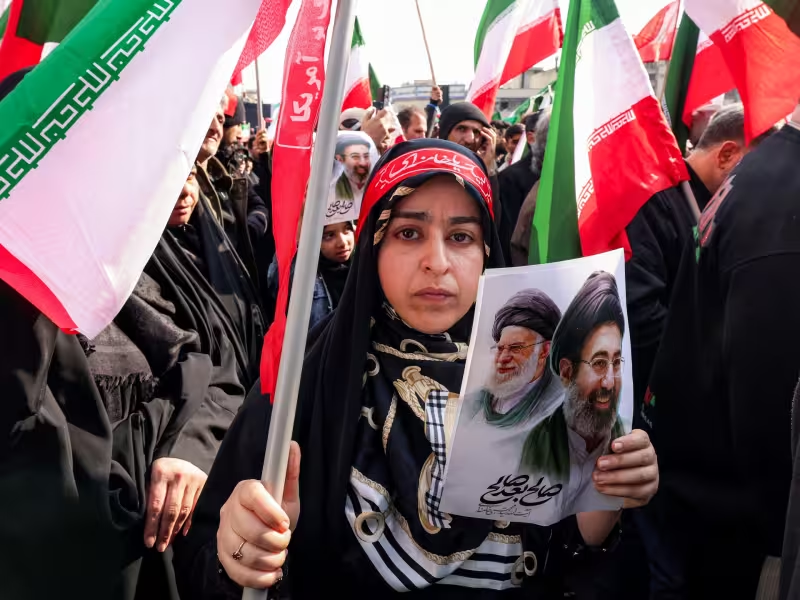
The disappearance of Mojtaba Khamenei from public view has sparked speculation that Iran’s supreme leader’s son was injured or even dead. The rumours have spread because his absence was sudden enough to stand out in a political system built to project control.
But the story is bigger than one missing man. Iran’s power consolidation is structural, not personal, and Ali Khamenei spent decades building the office of the supreme leader into an institution that does not depend on a single leader. That design matters now because the speculation over Mojtaba Khamenei has arrived at a moment when the system already has the machinery to absorb uncertainty.
The roots of that machinery go back to 1989, after the war with Iraq ended and Iran entered a prolonged phase of market-oriented restructuring. In 2006, Article 44 of the 1979 Constitution was amended to allow public and non-governmental entities to acquire up to 80 percent of shares in major state industries. The result was not a clean opening of the economy. From 2006 onward, assets moved on a large scale from government ministries to firms affiliated with the Islamic Revolutionary Guard Corps and religious-revolutionary foundations, including the Mostazafan Foundation, Setad, the Astan Quds Razavi Foundation and the Martyrs’ Foundation.

Read Also: Todd Meadows’ cause of death revealed as his mother urges network not to air footage
That network created a military-bonyad complex, tying coercive power to parastatal capital and making the state harder to separate from the organisations that profit inside it. Sanctions did not break that system apart. The United Nations Security Council imposed four rounds of sanctions between 2006 and 2010, and the United States expanded sanctions again after withdrawing from the nuclear deal in 2018. The article says the pressure inflicted immense damage on the broader economy while selectively empowering actors best positioned to operate through opacity, coercion and sanctions evasion.
Read Also: Trump Addressing The Nation Says Oil Over Iran War
That is the tension inside the current moment. The rumours around Mojtaba Khamenei suggest a succession drama, but the structure of power in Iran has been moving in the opposite direction for years. The real question is not whether one figure appears or disappears from view, but how a securitised state built to endure shocks will keep consolidating itself around the institutions already in place.