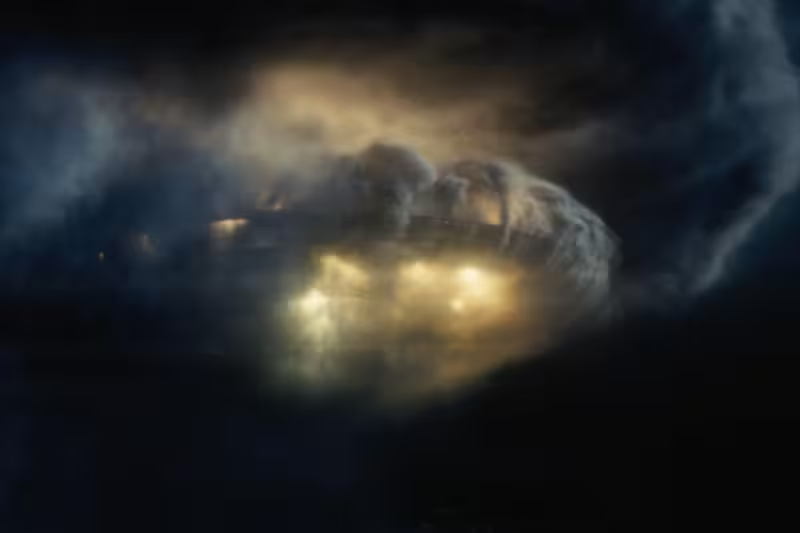
President Donald Trump has ordered the government to begin identifying and releasing files on alien life, unidentified aerial phenomena and unidentified flying objects, pushing one of Washington’s most persistent mysteries back into the spotlight. The directive calls for the process to begin on matters tied to UAP, UFOs and other information related to those subjects.
The move lands as Steven Spielberg’s highly anticipated film “Disclosure Day” is set for release in June 2026, a reminder that public fascination with the subject has hardly faded. But the real action is not in Hollywood. It is in the gap between what governments say they are willing to reveal and what many people believe they are still withholding.
Greg Eghigian, a professor of history and bioethics at Penn State University in University Park, Pennsylvania, said government gestures toward disclosure have produced two familiar reactions. Some people, he said, look at the published material and conclude it proves there is nothing unusual in sightings and reports. Others study the redactions and the missing pieces and decide the government is still sitting on vital secrets.
Read Also: Donald Trump Spurs Dow Jones Industrial Average 0.3% Gain Ahead


“The existence of secrecy means even apparent openness can be suspected of disguising more secrecy,” Eghigian said. He added that the appetite for disclosure is unlikely ever to be satisfied. That helps explain why each new release, hearing or directive tends to generate fresh scrutiny instead of closure.
Steven Dick, who published “Astrobiology, Discovery, and Societal Impact” in 2018, said his book does not spend much time on the UFO and UAP question. Even so, he said those phenomena are, in principle, “one of the scenarios that should be subject to a serious research program,” though he stressed that he is trying to keep an open mind about disclosure. He also said he prefers building equipment to acquire new data rather than revisiting old blurry images, and added, “I doubt much will be revealed in any ‘disclosure.’”
Read Also: Jared Kushner joins US delegation for direct Iran talks in Islamabad
Dick is a member of Avi Loeb’s Galileo Project at Harvard University, which says its goal is to move the search for extraterrestrial technological signatures from accidental or anecdotal observations and legends into mainstream, transparent, validated and systematic scientific research. He said recent congressional hearings included fantastic claims about alien technologies, bodies and other assertions, but that when it comes to locating such things, “the answer is always classified.”
The latest push for files may satisfy curiosity for a moment, but it will not end the argument. It is more likely to deepen the split between those who see disclosure as proof that nothing unusual is there and those who see every withheld line as evidence that the most important details remain out of reach.