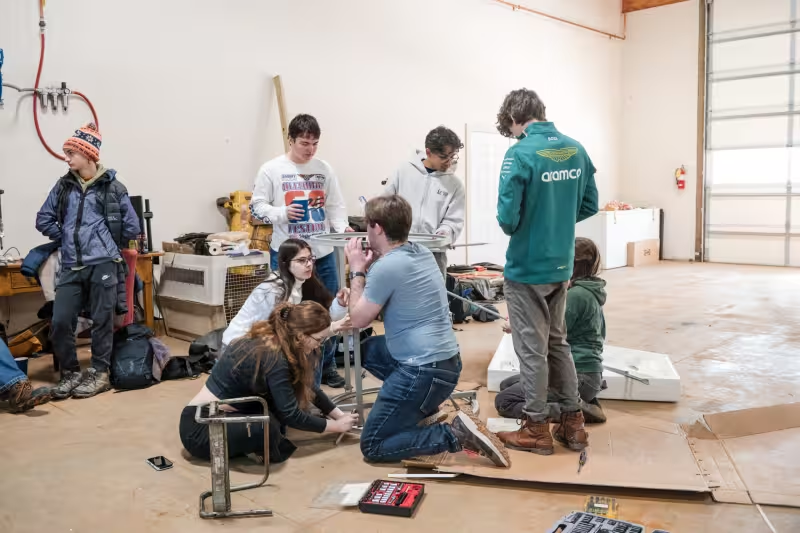
American University students tracked the Orion spacecraft’s radio waves during the 10-day Artemis II journey around the moon, part of a NASA test that put one of the school’s teams in a rare group of eight universities worldwide. The students worked from a Northern Virginia farm event center affiliated with the university, using a 2.5-meter-diameter satellite dish and software they wrote themselves to search for the spacecraft.
Senior Ankur Purao, who manages the about 12-member team, said the effort was more than a technical drill. “It’s really cool to be a part of this project,” he said, adding that “it’s the farthest humans have ever gone” and that he hopes to tell his children decades from now, “Hey, I was part of that, and I helped do something for the Artemis mission.”
Professor Michael Robinson, who advises the project at American University, said NASA selected the schools to judge whether universities can track objects as they leave Earth orbit. “NASA wanted to assess universities’ capabilities for tracking objects as they leave Earth orbit,” he said. “So find out: Where is it? How far is it? How fast is it moving?”
Read Also: NASA and Las Vegas Sphere turn dome into the Moon for Artemis 2
The work depended on more than enthusiasm. Purao said the team chose the Virginia site because it had the low radio noise they could not get in Washington, where broadcast signals would have interfered with the search. The students also spent time before and during the project writing software to program radios and other equipment to hunt for Orion as it moved through space.
Purao described the task as separating one faint signal from a screen full of static. “Essentially, just a little blip on a line on a computer screen, and trying to figure out which blip is the right blip,” he said, while also asking whether the team was seeing the spacecraft or “just a bunch of noise from whatever is out there.” He said the students believe they found the right signal: “We think we’ve seen it, yes,” he said.
Read Also: Artemis Photos show Earthset, eclipse and moon’s far side in rare flyby
The project matters because NASA is using the Artemis II flight to see whether university teams can help track spacecraft beyond Earth orbit, a skill that could matter as missions move farther from home. For American University, the test was also a measure of whether a student group with about 12 members can build the software, manage the gear and pick one useful signal out of the clutter. If the team’s read is right, its work did not just observe Artemis II. It proved the school can help follow the next one.