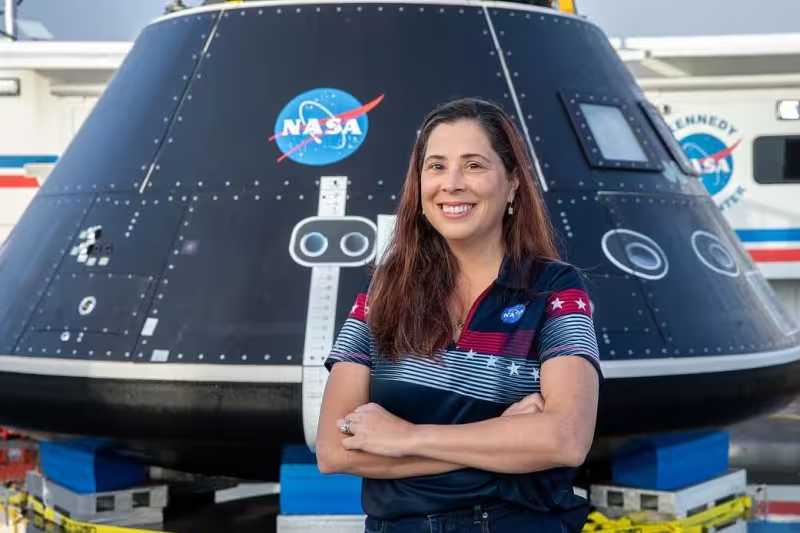
NASA has certified Kelsey Young, Trevor Graff and Angela Garcia as the first scientific officers for the Artemis II mission, putting three veteran flight controllers in charge of helping steer the mission’s science during the lunar flyby planned for Monday, April 6.
Young works at NASA’s Goddard Space Flight Center in Greenbelt, Maryland, while Graff and Garcia are based at NASA’s Johnson Space Center in Houston. NASA says the role is new for Artemis and places science inside Mission Control as a formal position, rather than leaving it as an add-on after the flight plan is set.
The certification comes after months of training, testing and mission-control simulations that included geology instruction, lunar observation exercises and integrated runs with astronauts. The agency has been folding science into crewed flight since Apollo, but Artemis gives that work a dedicated seat on the console. Young said scientific officers are senior flight controllers responsible for science and lunar geology goals during Artemis missions, and that they work with other console teams to keep lunar science objectives aligned with the rest of the flight.
That matters because the Artemis II crew is being asked to do more than circle the Moon. During the flyby, the astronauts are scheduled to photograph the lunar surface and record audio of what they see, turning a visual pass into a scientific exercise. They have already trained in geology in classrooms and in the field, studied landscapes in Iceland that resemble the Moon and worked to sharpen the way they describe what they are seeing so those observations have scientific value.
Graff said the simulations were one of the most rewarding parts of the process because they tested their skills in highly realistic mission scenarios. Young said what excites her most is hearing the crew describe the real Moon for the first time from Orion’s windows after months of hearing them practice those descriptions in simulation.
The move gives NASA a clearer path for turning Artemis flights into science-rich missions, not just transportation to lunar space. If Artemis II performs as planned, the agency will have shown that scientific work can be built into the rhythm of a crewed mission from the start, with officers in Mission Control and astronauts trained to notice the Moon as something to be studied as well as reached.