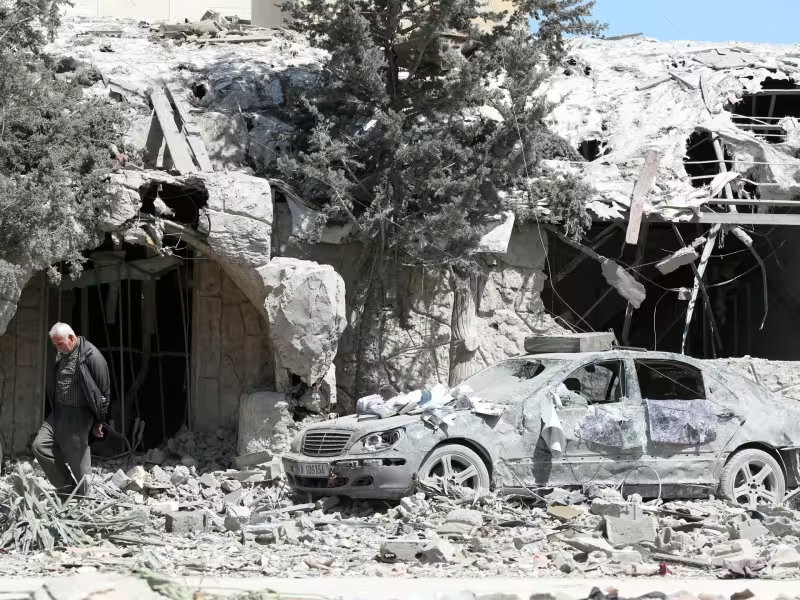
Iran’s parliament speaker warned that “time is running out” as Israel kept up attacks in Lebanon, even as the fighting eased from the scale seen earlier this week. There was still no ceasefire on the ground, but the violence had dropped sharply enough that there had been no Israeli strike in Beirut in the past 24 hours after a large-scale attack on Wednesday.
That lull did not mean the war had stopped. Israeli forces were still carrying out several airstrikes and artillery shelling in southern Lebanon, while Hezbollah kept firing rockets across the border and targeting Israeli troops inside Lebanese territory. The pattern underscored a conflict that has narrowed in intensity but not in purpose: each side is still striking, and neither has stepped back enough to call it peace.
The warning came from Mohammad Bagher Ghalibaf, who said time was running out as the regional pressure around Lebanon intensified. The US administration appears to be pressing Israel to accept at least a reduction in violence, if not a formal ceasefire, while Iran is insisting that the Lebanon front be included in any deal. That leaves Lebanon caught between outside bargaining and a war that still unfolds over its territory.
Israel’s last major hit on Beirut came Wednesday, and the absence of further strikes there for 24 hours has given diplomats something to point to, but not much more. On the border itself, the exchange of fire continues. Hezbollah has not stopped launching rockets, and Israeli forces have not stopped responding inside southern Lebanon.

The political route is no less tangled. The Lebanese government is again offering direct talks with Israel, but President Joseph Aoun is conditioning those talks on a ceasefire. Abed Abou Shhadeh said Israel is not interested in diplomacy or negotiations with Lebanon and is instead pursuing what he described as a policy of escalation through normalisation, keeping the war going in southern Lebanon while speaking with the government in Beirut.
That leaves little room for the kind of breakthrough that would satisfy all sides. The source said the issue is politically divisive in Lebanon and that the government has limited leverage, even as it tries to present direct talks as a path out of the fighting. Pakistan has also played an important role as a diplomatic mediator between global and regional powers, adding another layer to the effort to keep channels open.
Elsewhere in the region, Volodymyr Zelenskyy said Ukraine had shown several Middle Eastern nations how interceptor drones could be used against Shahed drones launched by Iran. He said, “We sent our military experts to the Middle East, including specialists in interceptor drones and electronic warfare,” and added, “We demonstrated to some countries how to work with interceptors.” Zelenskyy said the effort had worked across several countries, calling it a success. Even as the military details differ, the message across the region is the same: partners are looking for ways to blunt attacks without widening the war.
For now, Lebanon is living in that gap between escalation and ceasefire. The fighting has eased, but it has not ended, and the next move may depend less on the battlefield than on whether Washington, Tehran and Jerusalem can agree on what a reduction in violence is supposed to mean.