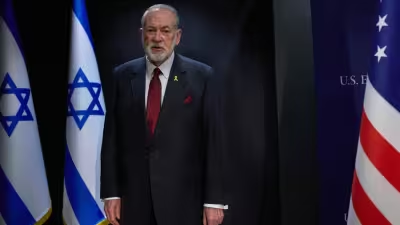
JD Vance left Islamabad on Sunday morning after 21 hours of talks with Iranian officials ended without an agreement, with both sides saying the latest effort to revive a Joint Comprehensive Plan Of Action-style deal had failed. Vance said the talks collapsed because Iran refused to abandon its nuclear weapons programme.
Vance said he and his team had been explicit about their red lines throughout the negotiations and that he had spoken with Donald Trump at least half a dozen times while the talks were underway. He said the United States needed an affirmative commitment that Iran would not seek a nuclear weapon or the tools to quickly achieve one. “That is the core goal of the president of the United States, and that’s what we’ve tried to achieve through these negotiations,” he said.
The American vice president said the breakdown was “bad news” and “bad news for Iran much more than it’s bad news for the United States of America.” On the Iranian side, parliament speaker Mohammad Bagher Ghalibaf said Tehran had offered “constructive initiatives” and accused Washington of being “unable to gain the trust of the Iranian delegation in this round of negotiations.”
Read Also: John Fetterman rebukes Democrats mocking Trump’s Iran ceasefire deal



Iran’s foreign ministry struck a softer note. Spokesperson Esmaeil Baghaei said no one had expected an agreement in a single session and said Tehran was “confident that contacts between us and Pakistan, as well as our other friends in the region, will continue.” Iran’s semi-official Tasnim news agency blamed excessive US demands for the deadlock. Pakistani foreign minister Ishaq Dar urged both sides to avoid renewed hostilities and said Pakistan would try to facilitate a new dialogue in the coming days.
The meeting in Islamabad was the first direct US-Iranian contact in more than a decade and the highest-level discussion between the two countries since the 1979 Islamic Revolution. It came against the backdrop of a war that began with US and Israeli strikes on Iran six weeks ago and a conflict that has killed at least 3,000 people in Iran, 2,020 in Lebanon, 23 in Israel and more than a dozen in Gulf Arab states. The US, Iran and Israel had agreed in the days before the talks to a 14-day ceasefire, but its future remains uncertain.
Read Also: Jared Kushner joins US delegation for direct Iran talks in Islamabad
That uncertainty gives the talks immediate weight beyond the room where they broke down. Israeli security cabinet minister Ze’ev Elkin said more talks were still possible and warned that “The Iranians are playing with fire.” The final outcome could help determine whether the fragile ceasefire holds and whether the strait of Hormuz reopens, a chokepoint for about 20% of global flows. For now, both sides are still talking about another round — but they are not talking about the same deal.