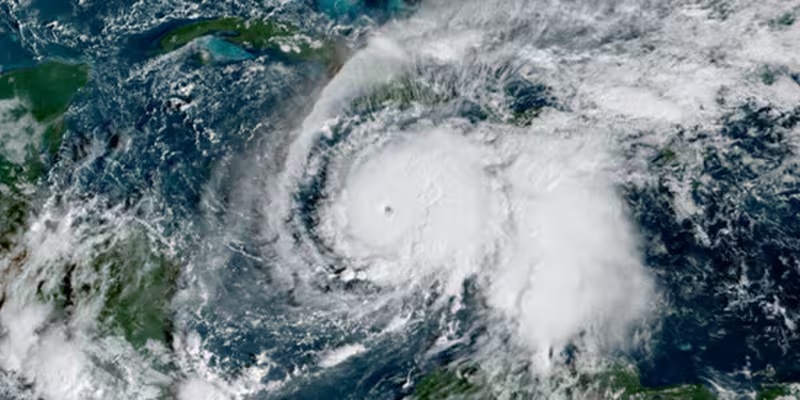
Colorado State University is forecasting a slightly below-average Atlantic hurricane season in 2026, saying on April 9 that the basin should see 13 named storms, six hurricanes and two major hurricanes. The team put Accumulated Cyclone Energy at 90, or 73% of average, and said the outlook is being pulled down by likely El Niño conditions this fall.
The forecast matters because it lands before the season begins and because it frames the coming months against both the 1991-2020 averages and last year’s busier-than-normal storm count. CSU’s numbers are below the long-term marks of 14.4 named storms, 7.2 hurricanes, 3.2 major hurricanes and an ACE of 123, and slightly weaker than last year’s 13 named storms, five hurricanes, four major hurricanes and ACE of 133.
The forecast also gives a 32% chance of a major hurricane hitting the United States, down from a 43% long-term average. For the East Coast or Florida Peninsula, the team sees a 15% chance, compared with a 21% average, while the Gulf Coast is put at 20% versus a 27% average. The Caribbean is forecast to have a 35% chance of seeing at least one major hurricane pass through, below the 47% long-term norm.

Read Also: Atlantic Hurricane Season Outlook Due Thursday as El Niño Signal Builds
Colorado State’s hurricane forecasting team uses a statistical model based on more than 40 years of past Atlantic hurricane statistics, along with dynamical model output from ECMWF, UKMET, JMA and CMCC. The latest outlook also comes after La Niña conditions ended in March and as NOAA said in its April 9 ENSO discussion that an El Niño watch continues in the Eastern Pacific, with ENSO-neutral conditions now in place. NOAA says an El Niño is likely to emerge in May-July 2026 with a 61% chance and persist through at least the end of the year, while the Climate Prediction Center sees about a 40% chance of a strong or very strong El Niño by year-end and NOAA is giving a 25% chance of very strong El Niño conditions.
That is the tension inside the forecast. The Atlantic season has not yet begun, but the Pacific setup is already shaping expectations for it. An unusually strong westerly wind burst is crossing the equatorial Pacific, and Columbia University’s International Research Institute for Climate and Society said on March 19 that the August-September-October peak of hurricane season carried a 77% chance of El Niño, a 21% chance of ENSO-neutral conditions and a 2% chance of La Niña. The last Atlantic season with an ACE below 90 was 2015, when ACE reached 63 during a strong El Niño year. CSU’s call suggests that pattern may be repeating in a quieter way, even if one storm can still change the season’s shape in a matter of hours.