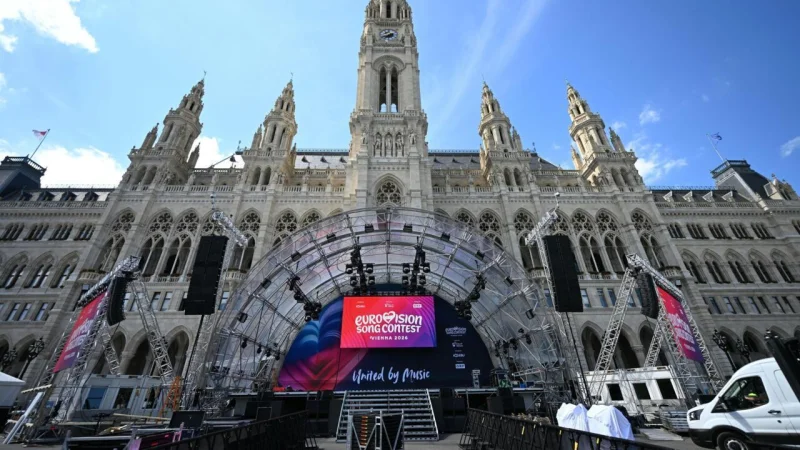
Eurovision 2026 is facing its biggest boycott in its 70-year history after five broadcasters pulled out of this week's event in protest at Israel's inclusion. The row has sharpened since Austria overtook Israel to win last May's contest and secure the right to host this year's competition.
UK viewers heard Graham Norton say organisers “will be breathing the largest sigh of relief that they're not faced with a Tel Aviv final next year,” a line that captured how far the contest's politics have spilled into the broadcast itself. That tension is now set against a field of 35 countries and a competition that has long sold itself as a night of music, not geopolitics.
The dispute has been building since before the Basel final, when several hundred people demonstrated in the Swiss city wearing Palestinian flags and smearing themselves with fake blood to symbolise the killings in Gaza. During the grand final, the Israeli singer Yuval Raphael was targeted when two people attempted to storm the stage, and paint thrown in the chaos hit a Eurovision crew member.
Raphael finished with middling points from the competition's judges but outperformed every other participant in the public vote, prompting questions from a number of broadcasters about how Israel placed so highly. Official social media accounts linked to Israel's government, including that of Prime Minister Benjamin Netanyahu, had asked people to vote for Israel's representative 20 times, the maximum the contest allowed.


The European Broadcasting Union said the vote had been independently checked and verified and that there was no evidence voting up to 20 times “disproportionally affects [sic] the final result.” It later clarified that the vote was “a valid and robust result.”
Israel first entered the Eurovision Song Contest in 1973 and has won it four times, but this year it is at the center of a fight that goes well beyond the stage. Broadcasters from Spain, Ireland, the Netherlands, Iceland and Slovenia have withdrawn from this week's event in opposition to Israel's inclusion, with some saying they are boycotting Eurovision 2026 because of the military offensive in Gaza that began in 2023.
That offensive, which followed Hamas's 7 October 2023 attack on Israel that killed around 1,200 people and took 251 hostage, has since left more than 72,000 people dead, according to Gaza's Hamas-run health ministry. Some broadcasters have accused Israel's government of genocide, an accusation Israel strongly denies.
What happens next is already plain: Eurovision 2026 will go ahead without a handful of national broadcasters, and the contest's organizers will spend the year trying to prove that the public vote, the rules and the show itself can still hold together under the weight of a war that has pulled Europe's campest television event into one of its darkest political arguments.