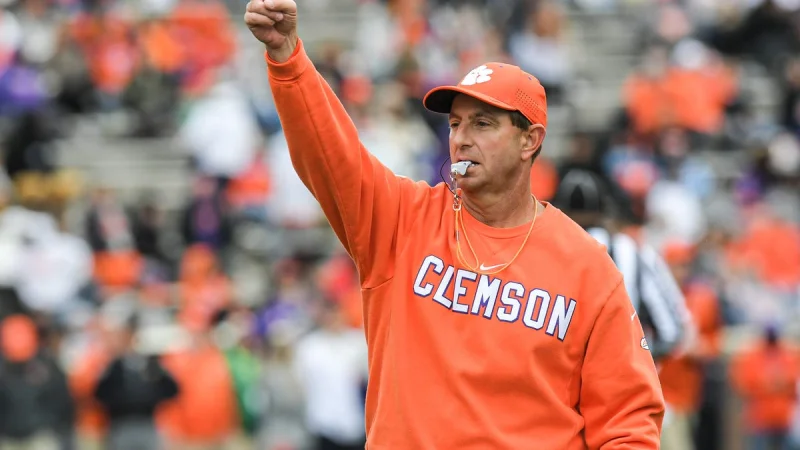
Dabo Swinney used a recent appearance on Greg McElroy’s Always College Football podcast to argue Clemson is fighting with less money than some of college football’s biggest brands, then pointed to Notre Dame as the clearest example of a program with structural advantages. Dan Patrick quickly pushed back, saying Swinney was making excuses for a team that once beat those same powers regularly.
Swinney said Clemson does not have the same NIL budget as some programs and does not have the same built-in resources from an alumni base and similar support. But he also said Clemson still has enough talent and resources to compete at the highest level, adding that the Tigers have enough and simply need to be good with what they have. He framed the debate with a blunt comparison: Clemson was 3-1 against Ohio State and 4-2 against Notre Dame, while Notre Dame has its own TV station, makes its own rules and prints its own money. He said Notre Dame has “a money machine in the backyard.”



Patrick came at the comments from the opposite direction. If a team is good enough to beat everybody, he said, there should be no complaint. He added that the point had nothing to do with Notre Dame or Ohio State because Clemson used to beat those teams. Patrick noted Clemson made six consecutive College Football Playoff appearances from 2015 to 2020, but has reached the playoff only once since then. He also said Clemson went 7-6 in 2025 and that Notre Dame had nine players drafted in the 2026 NFL Draft.
The exchange lands in the middle of a larger argument across college football about NIL money, transfer-portal spending and which programs are built to stay near the top when the rules change. Clemson’s run under Swinney once made that debate feel academic. Now the Tigers are part of it, and Patrick’s criticism suggested the patience for explanations has worn thin.
What Swinney is really defending is not just Clemson’s budget, but the idea that the program can still win without matching the biggest checkbooks. His answer was that Clemson has not changed as much as the sport around it. Patrick’s answer was sharper: the same coach who once owned the sport’s biggest stages is now being judged by whether Clemson can get back there.