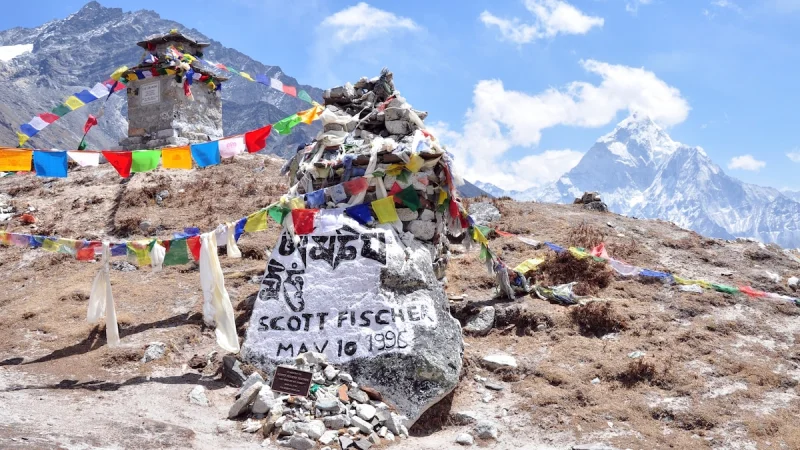
Jon Krakauer is looking back at the Everest disaster that made him famous, and the mountain that never really stopped changing after it. Thirty years after a squall swept across the upper reaches of Everest on May 10, killing eight climbers that night and 12 by the end of the 1996 season, Vintage Books is re-releasing Into Thin Air with a new foreword by the writer who was there.
Krakauer was on Everest in 1996 as a client of Kiwi Rob Hall’s Adventure Consultants, on assignment for Outside, and the magazine story became Into Thin Air. The book surged immediately to No. 1 on bestseller list, turning a commercial climbing disaster into one of the most widely read accounts of mountaineering ever published.
In his new foreword, Krakauer says he wishes he had never gone. He also says the early 1990s were the moment people started hiring guides on Everest, as the mountain moved from national expeditions into its commercial era. Scott Fischer once described that change as “a yellow brick road right to the summit,” and the line captured the lure of a peak that had become far more accessible to clients willing to pay for the chance.
That access did not make Everest safer. Krakauer said mass casualty events had become a regular feature of many seasons by the early twentyteens, long after the 1996 tragedy had seemed like the defining warning. He pointed to 2012, when four climbers could not get themselves down despite good weather, to a 2014 serac collapse that killed 16 Sherpa porters, and to the 2015 Nepal earthquake avalanche that took at least 19 lives in Base Camp.
The history Krakauer is revisiting is not just about one storm. It is also about how climbing Everest changed after 1996, when the market for guided summits kept growing rather than shrinking. By the early twentyteens, about 13,000 summiters had continued coming to Everest decade after decade, even as the mountain kept producing the kind of tragedies that once seemed unthinkable.
That is the tension at the center of Into Thin Air’s return. Krakauer’s book helped define the modern public understanding of Everest, but it did not discourage climbers. If anything, it helped supercharge the commercialization of the mountain, making the 1996 season both a warning and an advertisement at the same time.
Krakauer also used the new foreword to revisit the line he drew between the mountain’s familiar routes and its most dangerous ground. He said Alex Lowe guided Everest three times and got clients to the top twice, and that the only time Lowe did not get clients to the summit was on the Kangshung Face in 1994. He said Sandy Pittman’s expedition went to the nearly vertical 7,000-foot East Face, adding: “Nobody goes there.” He followed that with a blunt judgment on that terrain: “It’s almost suicidal.”
Everest had already been shifting before the disaster. In 1963, Tom Hornbein and Willi Unsoeld climbed the West Ridge, but the 1990s were the era when the mountain entered its guided phase in earnest. The new edition of Into Thin Air lands now because the 1996 storm is no longer ancient history on Everest; it is part of a long pattern of risk, profit and repeated loss that the mountain has carried into every season since.