Russia on May 7 said it will unilaterally halt fighting for Victory Day, but it paired the ceasefire with a new threat: a “massive” missile strike against Kyiv if Ukraine keeps attacking Russian or occupied areas. The announcement came hours after Volodymyr Zelensky said Moscow had answered Ukraine’s own ceasefire offer with more strikes and fresh warnings.
The Russian Ministry of Defense said its forces would stop all hostilities from midnight local time on May 8 until midnight on the morning of May 10. That would cover ground attacks, frontline drone and artillery strikes, and long-range drone and missile strikes. It also called on Ukraine to “follow this example,” framing the pause as a test of Kyiv’s intent rather than a concession by Moscow.
On the same day, Zelensky said Russia’s response to Ukraine’s May 5 to 6 unilateral ceasefire was not de-escalation but escalation. He said Moscow “wants Ukraine’s permission” to “safely take to Red Square for one hour once a year” for the Victory Day parade and then return to war. His remarks cut against the Kremlin’s public message that the holiday truce was a gesture of restraint.
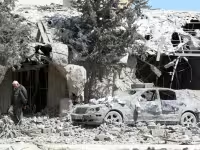


The timing matters because the ceasefire is tied to May 9, Russia’s Victory Day commemoration, one of the most politically charged dates on its calendar. Moscow has already warned of retaliation if Ukraine tries to disrupt the celebrations. Maria Zakharova said Russia would take “appropriate steps” if that happens, and the Russian Ministry of Defense repeated a May 4 warning that Ukrainian civilians and staff at foreign diplomatic missions should leave Kyiv immediately.
That warning is not theoretical. Zakharova said the foreign ministry had sent it to all foreign diplomatic missions and international organization offices because of the possibility of a retaliatory strike on Kyiv. Russian State Duma deputies went further, saying Russian forces may use Oreshnik intermediate-range ballistic missiles in such a strike and describing the threat as Russia’s “last warning to Brussels.”
The European Union said it is not changing its presence in Kyiv. Anouar El-Anouni said the bloc will keep operating in the city even after Russian strikes damaged several diplomatic missions there, including the EU mission to Ukraine. That leaves the capital exposed to another round of brinkmanship in the middle of a holiday that Moscow says it wants to honor under arms.
The clearest takeaway is that Russia’s Victory Day pause is being presented less as a path out of fighting than as another stage in the pressure campaign around Kyiv. If the truce holds, it will last only through May 10. If it does not, Moscow has already said what it is prepared to do next.