Ambassador Greer said on Friday that the United States will allow preferential duty access for whiskey produced in the United Kingdom, framing the move as part of a wider economic deal between Washington and London.
Greer issued the statement in Washington on the day President Trump announced the whiskey access change, underscoring that the tariff treatment is not a standalone step. It is tied to the continuing implementation of the Economic Prosperity Deal, a framework the two countries jointly announced last year.
“Last year, the United States and the United Kingdom jointly announced the General Terms for an Economic Prosperity Deal, where the U.S. secured increased access into the U.K. for American beef and ethanol,” Greer said. “More recently, we announced a historic pharmaceutical deal that will drive investment and innovation in both countries.”
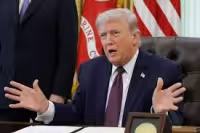


He said the whiskey arrangement follows the same path. “As part of the EPD, the U.S. and UK have decided that in continuing its implementation, the United States will allow preferential duty access for whiskey produced in the United Kingdom, along with preferential treatment for other American and British goods,” Greer said.
The sequence matters because it shows the trade pact moving from broad promises into specific market access changes. The United States already won increased access for American beef and ethanol in the earlier phase, and the pharmaceutical agreement added a new layer to the deal more recently. The whiskey decision now extends that pattern to another high-profile product.
The friction in the statement is that the new preferential treatment is being sold as reciprocal even as the latest announcement centers on a U.K. product. Greer’s remarks make clear that the White House is presenting the change as part of a package, not as a one-off concession, and that other American and British goods are also covered.
For businesses watching the talks, the immediate takeaway is that the trade relationship is still being actively reshaped, with whiskey now joining beef, ethanol and pharmaceuticals in a deal that is being rolled out in pieces. The next question is how quickly the preferential access will filter into actual trade terms for producers on both sides of the Atlantic.