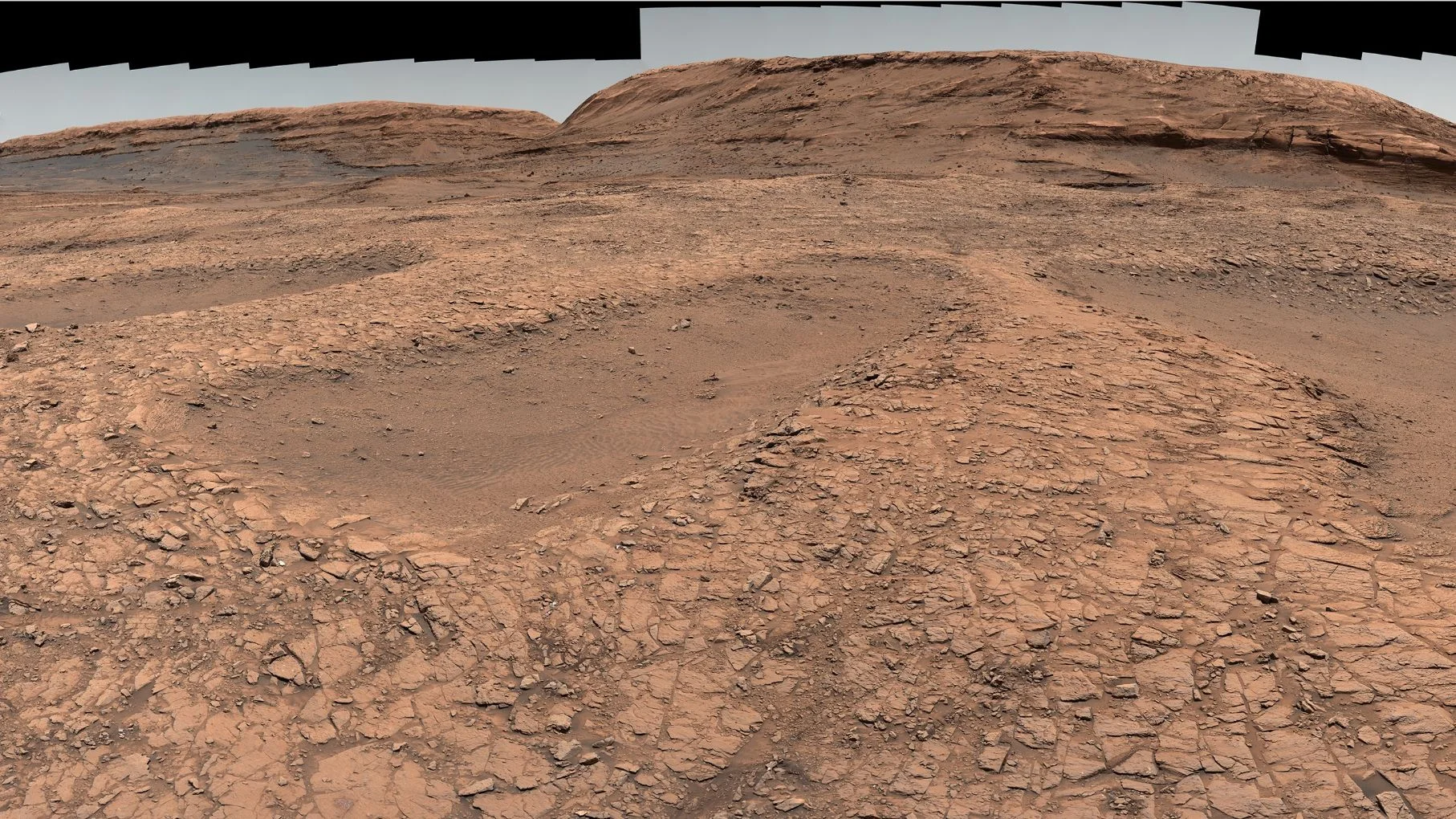
NASA has released a pair of sweeping new panoramas from its two active Mars rovers, Curiosity and Perseverance, giving a fresh look at landscapes that were captured thousands of miles apart. The images, stitched from hundreds of individual frames, were assembled into some of the most detailed views yet sent back from the Red Planet.
Perseverance’s panorama was taken in an area nicknamed Lac de Charmes near the rim of Jezero Crater, where the rover has been exploring since its February 2021 landing. Its mosaic combines 980 images collected between Dec. 18, 2025 and Jan. 25, 2026, and shows rugged terrain carved by ancient water activity, with layered rocks and scattered boulders spread across the view. The region around Jezero Crater once held a lake and river delta billions of years ago, making it one of nasa’s most closely watched sites in the search for signs of past microbial life.

Curiosity’s latest panorama comes from deep within Gale Crater, where the rover has spent years climbing the foothills of Mount Sharp. That mosaic is made up of 1,031 images taken between Nov. 9 and Dec. 7, 2025, and it highlights a network of low ridges known as boxwork formations. NASA says the ridges were formed when groundwater moved through large fractures in the bedrock, left minerals behind and those minerals later resisted erosion. Curiosity has also identified carbonate minerals such as siderite and increasingly diverse organic molecules on Mars, with NASA saying some of the organic compounds are among the largest and most complex ever detected there.
The two panoramas show why the rovers keep mattering long after their landings. Perseverance is reading one chapter of Martian history in Jezero’s lakebed terrain, while Curiosity is working through another in Gale’s ancient rock layers, and NASA says the separate landscapes are helping reveal different parts of the planet’s past. For readers following the agency’s science releases, the images arrive as a reminder that its Mars work can still deliver something immediate and arresting, much like the personal name images from Landsat Nasa Name tool or the Earth-facing hook in Nasa Your Name Landsat, only this time the canvas is Mars itself, not Earth.
The release also lands while Curiosity is pushing through its nearly 15-year mission and Perseverance continues a search that began with its 2021 touchdown. Together, the panoramas do not just show where the rovers are. They point to what each site was when Mars was wetter, and to the next round of clues scientists will pull from the rocks beneath them.