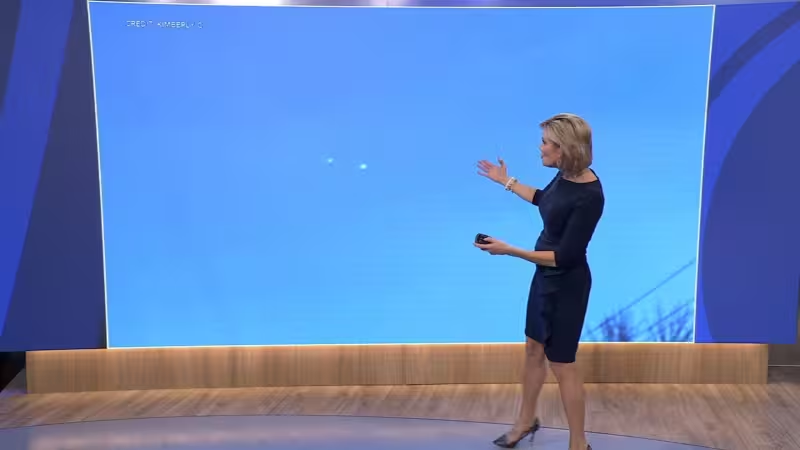
A fireball meteor lit up the afternoon sky Tuesday and was seen by more than 200 people across five states, streaking from above the Atlantic Ocean off Long Island to the skies over New Jersey before breaking apart. NASA said the meteor first became visible around 2:30 p.m., 48 miles above the ocean off Mastic Beach, New York, and traveled 117 miles before disintegrating 27 miles above Galloway, New Jersey.
The object was moving at 30,000 miles per hour, NASA said, fast enough to send it tearing through the upper atmosphere in a display that lasted long enough for people in Pennsylvania, Delaware, New Jersey, New York and Connecticut to spot it. The size of the audience mattered because meteors are quite common, NASA said, but they usually occur over the ocean or unpopulated areas, where far fewer people can watch the sky catch fire.
Nicholas Samuelian was driving on Route 70 in Medford Lakes when he saw the bright light overhead. “I didn't know what to think at first I never seen anything like that, so it was one of the craziest things I have ever seen,” he said. He said the object then began breaking into pieces and flashes of light, a moment that sent him reaching for his phone.
Read Also: Meteor Fireball Streaks Across Tri-State Sky, Seen in Five States

“Immediately after that it started breaking up into pieces and there were all different flashes of light and that's when I realized I should grab my phone and start taking a video,” Samuelian said. Nicholas Brucato of Manchester Township said he saw the same streak cross the sky and began recording it. “I had my phone in my hand thankfully and I started recording it and I thought it was pretty cool, and then two to three minutes later I heard a big boom,” he said.
Brucato said he was not sure whether the sound was connected. “I don't know if that was related at all. I'm not sure,” he said. He later posted the video to a Facebook group, saying, “After that I posted it to a Facebook group and it just blew up from there.” NASA said meteors traveling through Earth's atmosphere at hypersonic speeds can eventually lead to sonic booms, which fits the delayed bang Brucato described, though the agency did not say the sound was definitively from this object.
Read Also: Fireball Sighting Pennsylvania New Jersey Seen Over 5 States Tuesday
NASA said February through April is peak fireball season, when especially bright meteors are more likely to be noticed. The agency said a meteoroid becomes a meteor when it enters Earth's atmosphere and begins to burn, a fireball is a meteor brighter than Venus and a meteorite is a fragment that survives the trip and hits the ground. In this case, the object burned up before reaching the surface, leaving skywatchers with a flash, a boom and a brief mystery that ended with the meteor gone and the witnesses still talking about it.