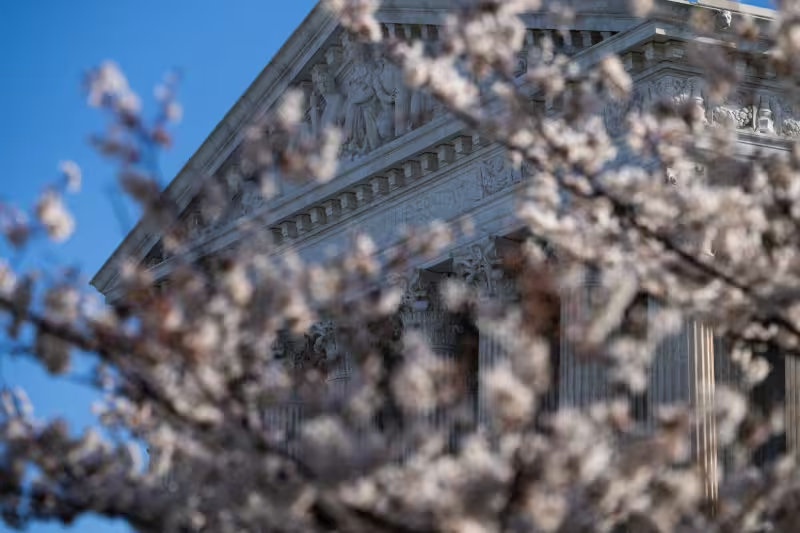
The Supreme Court is set to hear oral arguments Tuesday in a fight over how far the Federal Communications Commission can go when it says a company broke the law. AT&T and Verizon are asking the justices to throw out FCC forfeiture orders that found the carriers violated consumer privacy rules and assessed $57 million against AT&T and $47 million against Verizon.
The companies say the process Congress created in 1960 cannot stand because it denies them the constitutional right to a jury trial. Congress first gave the FCC forfeiture authority that year against broadcasters and telecommunications companies, and the agency used that power again in 2024 when it issued forfeiture notices to AT&T, Verizon and others over alleged data privacy violations tied to incidents in which third parties could gain access to users’ location data from aggregator companies with contracts with the carriers.
That fight has already split the lower courts. AT&T took its case to the U.S. Court of Appeals for the 5th Circuit, which threw out the forfeiture and held that the law violated the company’s 7th Amendment right to a jury trial. Verizon went to the 2nd Circuit, which upheld the FCC proceedings. The Supreme Court will now decide whether the agency’s in-house process passes constitutional muster or whether companies must get a jury before the government can turn a finding of wrongdoing into a financial penalty.


The Trump administration, defending the FCC at the high court, argues that the agency’s determination is not itself a binding judgment. It says the notice the FCC issues is only a warning that a company may face legal liability later, and that a finding of wrongdoing alone does not force payment. In the administration’s words, “Congress went beyond the constitutional minimum by directing the Commission to issue a notice of apparent liability and provide an opportunity to respond in writing,” before any collection effort can proceed.
A ruling for AT&T and Verizon would not stop at telecom regulation. It could also reach dozens of agencies that use similar internal adjudication systems, from consumer protection to broadcasting, and it would narrow a method federal regulators have relied on for roughly 20 to 30 years. Daniel Lyons, a professor who has followed the issue, said the short-run policy effects would be “really significant,” adding that agencies would end up doing a lot less than society has expected them to do over the last 20-30 years.
For now, the FCC cases sit at the center of a broader question about how far federal agencies can go when they police their own rules. Companies can challenge those findings in a federal appeals court or wait for the Justice Department to sue to collect the money and then seek a jury trial. That makes Tuesday’s argument more than a fight over privacy penalties for AT&T and Verizon; it is a test of whether the government can keep using a system that turns an agency finding into leverage without going through a jury first. The outcome could reshape not just these forfeitures, but the way the FCC and other agencies enforce the law.