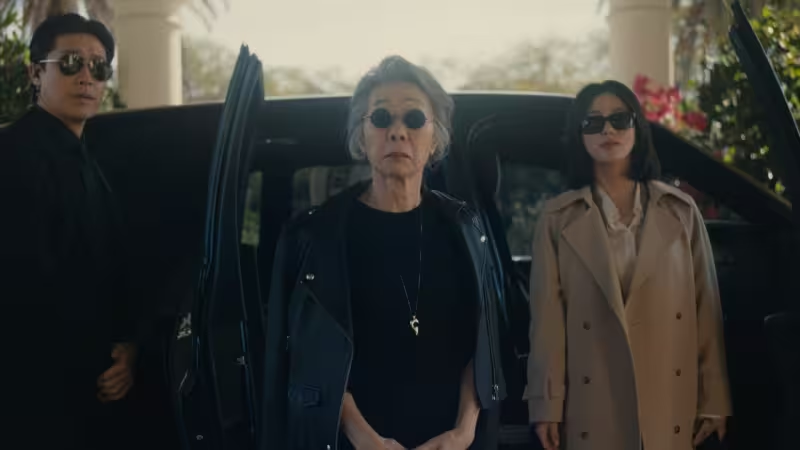
Beef is back on Netflix today with season two, and Lee Sung Jin has traded the first run’s road-rage spiral for a new fight over money, pedigree and power. This time, the drama moves to a country club in Montecito newly bought by Chairwoman Park, a South Korean billionaire who is always addressed by her title.
Park sits at the center of the season as the head of a Korean conglomerate, and one character claims she personally represents 2% of South Korea’s GDP. That is the kind of line Jin can now write from the inside of a hit. He said the first season made him realize how tempting that world can be. “You start to feel important,” he said. “I didn’t like feeling that, but I thought it was juicy.”



The new setting matters because it puts Beef inside the world of chaebols, the family-run corporations that helped shape South Korea’s economy after the war. Korea was primarily agricultural until the mid-20th century, and by 1953 its industrial facilities had mostly been reduced to rubble after the Korean War, leaving the economy paralyzed. After that, the government chose select families to buy ex-Japanese colonial-era assets at rock-bottom prices, then backed them with tax breaks and favorable loans. Those family-led companies expanded fast into international trade and manufacturing, and they still sit close to the center of Korean society today.
That history gives Park’s wealth and prestige a political charge that reaches far beyond the country club gates. Many Koreans of her generation have long-standing beef with Japan, which occupied Korea under colonial rule from 1910 to 1945, and the shadow of that period still hangs over the story. South Korea now has one of the world’s 15 largest GDPs, with semiconductors as its top global export, but the route to that rise was built through the post-colonial break that created the chaebol class.
That is where Beef season two finds its friction. Jin is not just using a richer setting; he is putting his characters inside the system that made modern Korean power possible and asking what happens when status becomes the thing everyone in the room is chasing. With an all-new cast and locale, the show is not repeating its first-season formula. It is widening the lens, and it does not look gentler for it.