Nvidia shares are headed for their worst performance since 2022, a sharp slowdown for the world’s most valuable chipmaker after two years of blowout gains. The stock is up only 6% so far in 2025, far below the 171% jump in 2024 and another 39% rise before the pace cooled this year.
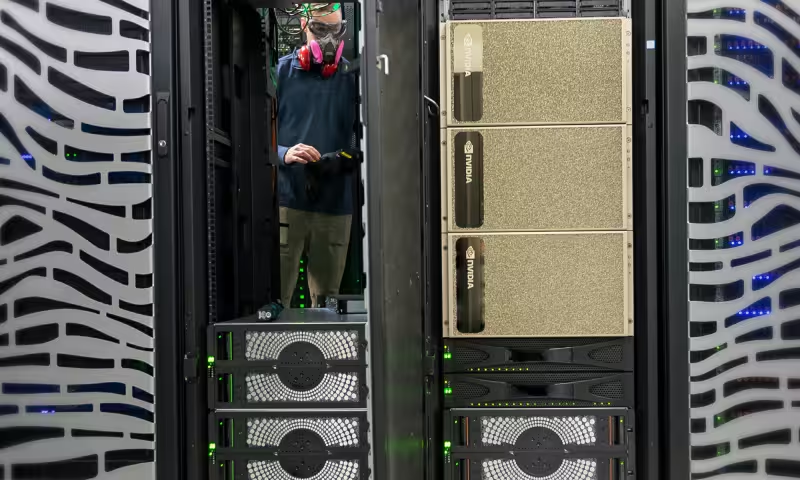
The pullback comes even as the AI spending wave keeps building. Alphabet, Microsoft, Amazon and Meta Platforms have said they will spend up to $700 billion in capital expenditures this year, much of it on the infrastructure needed to build data centers and support AI platforms. That money still flows through Nvidia, whose Hopper and Blackwell chips are widely seen as the gold standard for designing, training and running advanced AI systems.
The scale of the business is still enormous. Nvidia reported $68.1 billion in revenue in the fourth quarter of fiscal 2026, up 73% from a year earlier, including $62.3 billion in data center sales that rose 75%. The company said its vast majority of revenue continues to come from data center chip sales, a business that has turned Nvidia’s market value into the largest in the stock market over the last two years as its GPUs became central to the AI boom.



Jensen Huang has argued the runway is still ahead. “Our customers are racing to invest in AI compute -- the factories powering the AI industrial revolution and their future growth,” he said. At Nvidia GTC 2026, he also forecast that Nvidia could reach $1 trillion in AI revenue by the 2027 calendar year, a target that underlines how aggressively the company is trying to extend its lead as it rolls out its next-generation Rubin chips this year.
The tension is that Wall Street is still paying a relatively modest price for that growth. Nvidia’s forward price-to-earnings ratio is 23.9, well below its three-year mean of 79, suggesting investors are no longer valuing the company as if every quarter will repeat the last. Even after its enormous 2024 and 2025 gains, the stock’s gains this year leave it looking more like a maturing giant than an untouchable momentum trade.
Nvidia said it received $215.9 billion in revenue in the 2025 calendar year, a figure that shows how far the company has already scaled before Rubin arrives. The question now is not whether AI spending is real. It is whether the market still believes Nvidia can keep turning that spending into growth fast enough to justify what comes next.