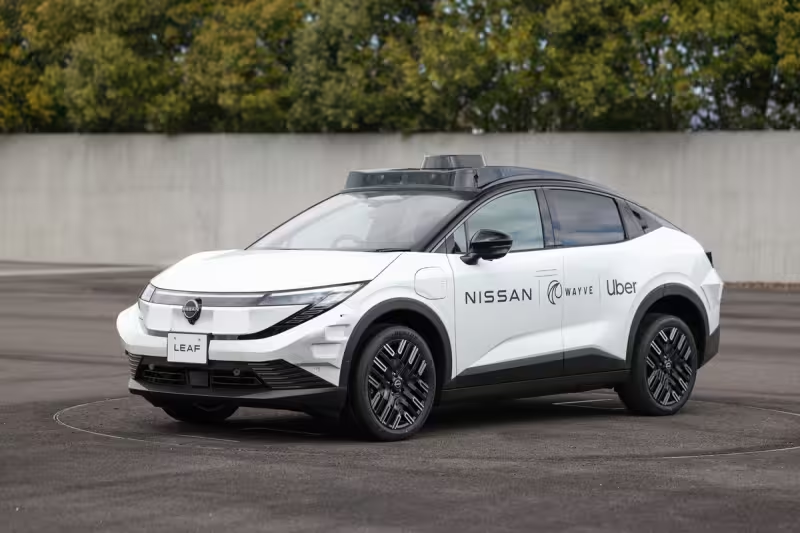
Uber has committed more than $10 billion to autonomous vehicles and to taking stakes in the companies building them, a sharp reminder that the company that once sold itself as asset light is now willing to own a far larger piece of the machine underneath its rides. The Financial Times calculated the total earlier this month, putting about $2.5 billion of that money into direct investments and another $7.5 billion into robotaxi purchases over the next few years.
Jiten Behl, who was interviewed earlier this month about Eclipse’s new $1.3 billion fund, said the firm is working on a couple of very cool ideas. His comment lands at a moment when Uber’s spending is not just theoretical. It is already spread across WeRide, Lucid, Nuro, Rivian and Wayve, and it points to a strategy that now looks less like a bet on one in-house breakthrough than a broad campaign to secure access to the vehicles that could carry the business into its next phase.

That marks a long way from Uber’s first run at autonomous driving. Between 2015 and 2018, the company launched Uber Elevate and Uber ATG, acquired Otto in 2016 and bought micromobility startup Jump in 2018. Four years later, in 2020, it sold Uber ATG to Aurora, Jump to Lime and Elevate to Joby Aviation, while keeping equity stakes in Aurora, Lime and Joby after the deals closed.
The change matters because Uber originally moved with a plan to stay asset light, then gradually stepped into businesses that required more capital and more physical infrastructure. The current approach is even more direct: rather than trying to develop autonomous technology entirely in-house, it is focusing on owning or leasing the assets that make the service work. That shift helps explain why the company is now comfortable backing a wider set of players and locking in future robotaxi supply at scale.
Travis Kalanick has already said Uber made a mistake when it abandoned its autonomous vehicle development program, a rare admission from the company’s founder about one of its biggest strategic reversals. Now the question is not whether Uber will try to be involved in autonomous transport. It already is. The real issue is whether this mix of investments, equity stakes and vehicle purchases can finally deliver the control over the business that its first autonomous push never quite managed.