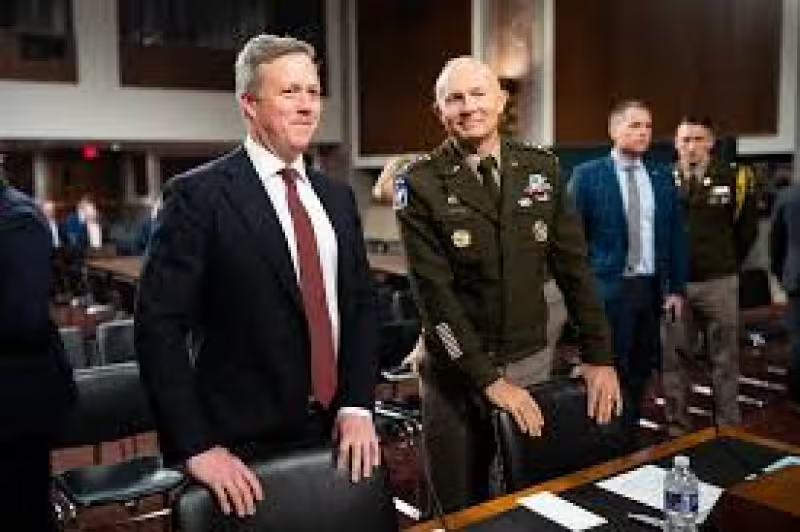
Defense Secretary Pete Hegseth asked Army Chief of Staff Gen. Randy George to step down and take immediate retirement on April 2, 2026, ending the tenure of the Army’s top officer well before its expected finish. Sean Parnell said George will be retiring from his role as the 41st Chief of Staff of the Army effective immediately, and the Army said Gen. Christopher LaNeve will serve as acting chief of staff.
LaNeve previously served as Hegseth’s military aide, a detail that underscores how closely the defense secretary has tried to align the Pentagon’s top jobs with his own team. Hegseth has now fired more than a dozen senior military officers, and the latest move adds two more Army officers to the list: Gen. David Hodne, who led the Army’s Transformation and Training Command, and Maj. Gen. William Green, who headed the Army’s Chaplain Corps.
A senior Defense Department official said it was time for a leadership change in the Army. Parnell described LaNeve as a battle-tested leader with decades of operational experience who is completely trusted by Hegseth to carry out the administration’s vision without fault. George, who was nominated by President Joe Biden and confirmed by the Senate in 2023, would typically have remained in the post until 2027.



Read Also: Pete Hegseth pushes out Army chief Gen. Randy George, who says soldiers deserve courageous leaders
The removal lands after a stretch in which George had still been presented as an active, engaged Army chief. West Point posted photos on March 25 of him visiting cadets and offering guidance drawn from his own experience. He had served as the Army’s vice chief of staff from 2022 to 2023 and earlier as the senior military assistant to Defense Secretary Lloyd Austin during the Biden administration, making him a familiar figure inside the Pentagon’s leadership ranks.
The overhaul also comes against the backdrop of another Hegseth decision that rattled the Army last weekend, when he overruled the service on the suspension of the aircrew that flew by Kid Rock’s house in Nashville. On his personal X account, Hegseth wrote, “No punishment. No investigation. Carry on, patriots.” Taken together, the moves show a defense secretary willing to drive personnel decisions from the top and to override the military chain when he thinks it fits his politics.
George’s exit is more than a routine personnel shift. The Army chief of staff normally serves a four-year term, and the abrupt retirement of an officer confirmed just three years ago signals that Hegseth is still reshaping the senior military ranks far faster than the institution would usually allow.